MISSION CRITICAL RF PRODUCTS

Mission Critical DMR & TETRA

Professional RF coverage products for mission-critical radio networks, including repeaters, BDAs and fiber DAS platforms across VHF, UHF, 800 MHz and 700-800 MHz.

Product Groups

Select a product group to continue to the relevant product family and technical specifications.

VHF

VHF BDAs, repeaters and Fiber DAS solutions for mission-critical LMR, DMR, P25 and analog radio networks.

TETRA DMR P25 400MHz

UHF 380-512 MHz repeaters, Fiber DAS and 19-inch rack systems for DMR, TETRA, P25 and LMR applications.

TETRA DMR 800MHz

High-performance repeaters and Fiber DAS solutions for 800 MHz mission-critical and public-safety networks.

DMR 700-800MHz

Dual-band 700/800 MHz repeaters and Fiber DAS platforms for public safety and mission-critical applications.

LTE For Mission Critical Application

LTE coverage and RF distribution products for resilient mission-critical voice, data and broadband communications.

GSM-R

RF repeaters and DAS solutions designed for railway stations, tunnels, tracks and other rail infrastructure.

Can't find the mission-critical RF product you need?

Only a selection of EMTS mission-critical RF products is presented on this website. Our complete portfolio includes a much broader range of frequencies, power levels, configurations and customized systems. If you cannot find the product you require, please contact us.

Mission-Critical RF Coverage Solutions

Engineered for public safety, transportation and critical infrastructure communications

EMTS Telecom Services specializes in the engineering and manufacturing of high-performance RF coverage-enhancement systems for mission-critical communications. Our portfolio is designed to provide reliable and continuous voice and data connectivity for first responders, public-safety organizations, transportation networks and critical infrastructure.
First responder using mission-critical radio
Mission-critical voice communications for first responders and public-safety teams.
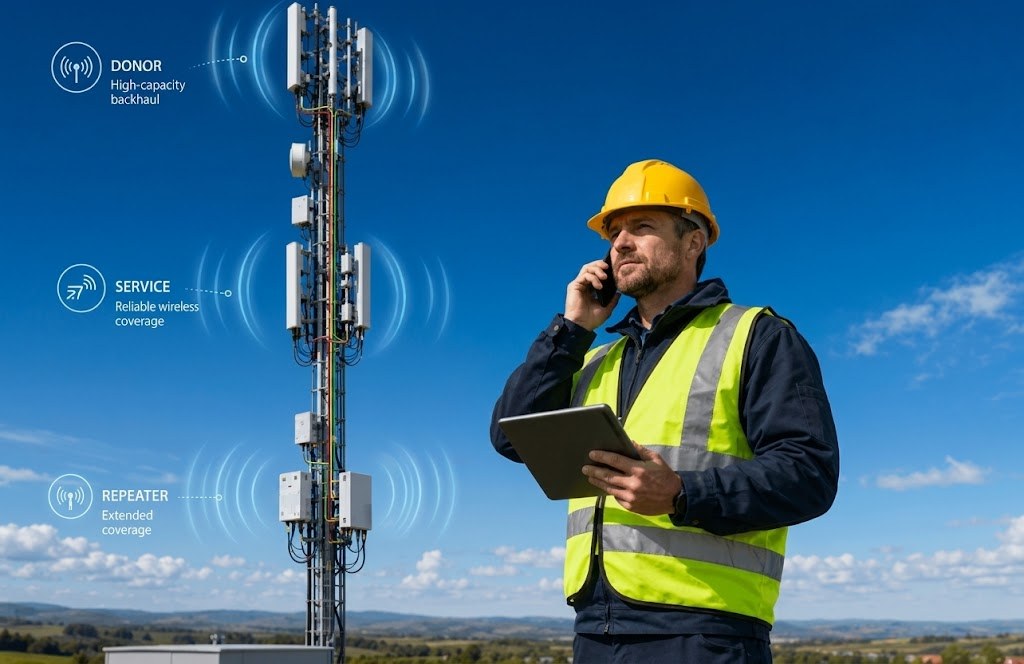
Mission-critical repeater deployment
Illustrative donor, service and repeater coverage architecture.

Bi-Directional Amplifiers & RF Repeaters

High-linearity BDA and repeater platforms with output-power options ranging from compact 20 dBm units to 40 dBm high-power band-selective and channel-selective systems.

Fiber Optic DAS

Scalable Master Unit and Fiber Remote Unit architectures designed to extend RF coverage across large buildings, tunnels, underground facilities, campuses and outdoor environments.

In-Line RF Boosters & Active Components

High-efficiency RF amplification devices designed to compensate for cable and passive-distribution losses in complex in-building and distributed antenna networks.

Wide Frequency & Multi-Technology Support

Solutions are available across VHF, UHF 380-512 MHz, 700 MHz, 800 MHz and GSM-R frequency ranges, with additional customized configurations available.

Mission-Critical Standards

Support for TETRA, DMR, APCO P25, LMR, PMR, GSM-R and mission-critical LTE applications.

Reliability, Protection & Monitoring

ALC, isolation monitoring, oscillation protection, rugged configurations and remote management capabilities are available on selected platforms.

TETRA and DMR Coverage Solutions for Mission-Critical Networks

TETRA and DMR coverage solutions keep professional radio users connected inside buildings, tunnels, stations and industrial sites that the outdoor network cannot reach. For example, police, fire and ambulance services, transport operators and utilities rely on these radios for voice and data, so in-building coverage needs the same careful planning as the outdoor network.

EMTS develops bi-directional amplifiers (BDA), off-air repeaters, in-line boosters and fiber DAS for TETRA, DMR, P25 and analog land mobile radio (LMR) systems. The product groups below are organised by frequency band.

TETRA and DMR product groups by band

  • VHF: band selective and channel selective BDAs, an in-line booster and a VHF fiber remote unit
  • TETRA, DMR and P25 400 MHz: repeaters, BDAs in 19 inch enclosures, in-line boosters, and fiber DAS master and remote units
  • TETRA and DMR 800 MHz: band selective BDAs, a tunable bandwidth high power repeater, in-line boosters and fiber DAS
  • DMR 700 to 800 MHz: dual band 700/800 MHz repeaters from 20 dBm to 40 dBm and a fiber remote unit
  • LTE for mission-critical applications: band and channel selective LTE repeaters and in-line boosters
  • GSM-R: band selective and channel selective repeaters for railway networks

BDA, in-line booster or fiber DAS?

A band selective BDA amplifies a whole frequency band and suits smaller buildings or sites with a single radio system. In contrast, a channel selective BDA filters individual channels, which helps where several networks operate close together and only specific channels should be amplified. Meanwhile, in-line boosters compensate for cable and splitter losses inside an existing distribution system or tunnel.

However, for large or multi-level sites, a mission-critical fiber DAS distributes the signal from a master unit to remote units over optical fiber and avoids the loss of long coaxial runs.

What to prepare for a TETRA or DMR coverage project

  • Radio standard and the exact frequencies or channel list
  • Donor site location and received signal level
  • Coverage areas, including stairwells, basements and tunnels
  • Applicable codes and requirements of the authority having jurisdiction
  • Backup power, alarm and monitoring requirements

In addition, product listings and certifications must be confirmed for each specific model and project. For a step-by-step planning guide, read TETRA and DMR Coverage: Planning Reliable In-Building Communications.

Frequently asked questions about TETRA and DMR coverage

Do EMTS products support P25?

Several 400 MHz, 700/800 MHz and VHF products are specified for P25 as well as TETRA, DMR and analog systems. Even so, check the datasheet of the selected model.

What is the difference between a repeater and a BDA?

In professional radio the terms are often used interchangeably. In both cases, the equipment amplifies the downlink and uplink signals between a donor site and the coverage area.

Contact EMTS to plan reliable mission-critical radio coverage.