
OUR SOLUTIONS
Advanced RF Solutions for Mobile Networks, Mission-Critical & Specialized Applications
Single Source Supplier
RAN, DAS, antennas, amplifiers and passive components from one vendor.
End to End Engineering
Survey, design, BoM, commissioning and full code documentation.
Long Product Lifecycle
Support for deployments over 10+ year operational lifetimes.
Explore Our Solutions
In-Building Solutions (IBS)
Active, Hybrid and Passive DAS, repeaters and BDAs for multi operator, 5G ready in building coverage.
Public Safety / TETRA / DMR DAS Solutions
TETRA, DMR and P25 coverage, with equipment and installation requirements reviewed for each project.
LTE / 5G One Box Network
Private and deployable LTE/5G network solutions, configured for project requirements.
High-Power Linear Amplifiers
High-linearity RF power amplifiers with application-specific frequency, output power and linearization options.
Drone Detection and Elimination Tactical Solutions
Multi sensor drone detection, tracking and precision RF mitigation.
In-Building Solutions (IBS)
Wireless Coverage. Built for the 5G Era.
Modern construction blocks the very signals occupants depend on — Low-E glass, metallized insulation, and reinforced concrete create a wireless paradox, just as 5G capacity demands and Public Safety codes raise the bar on indoor coverage.
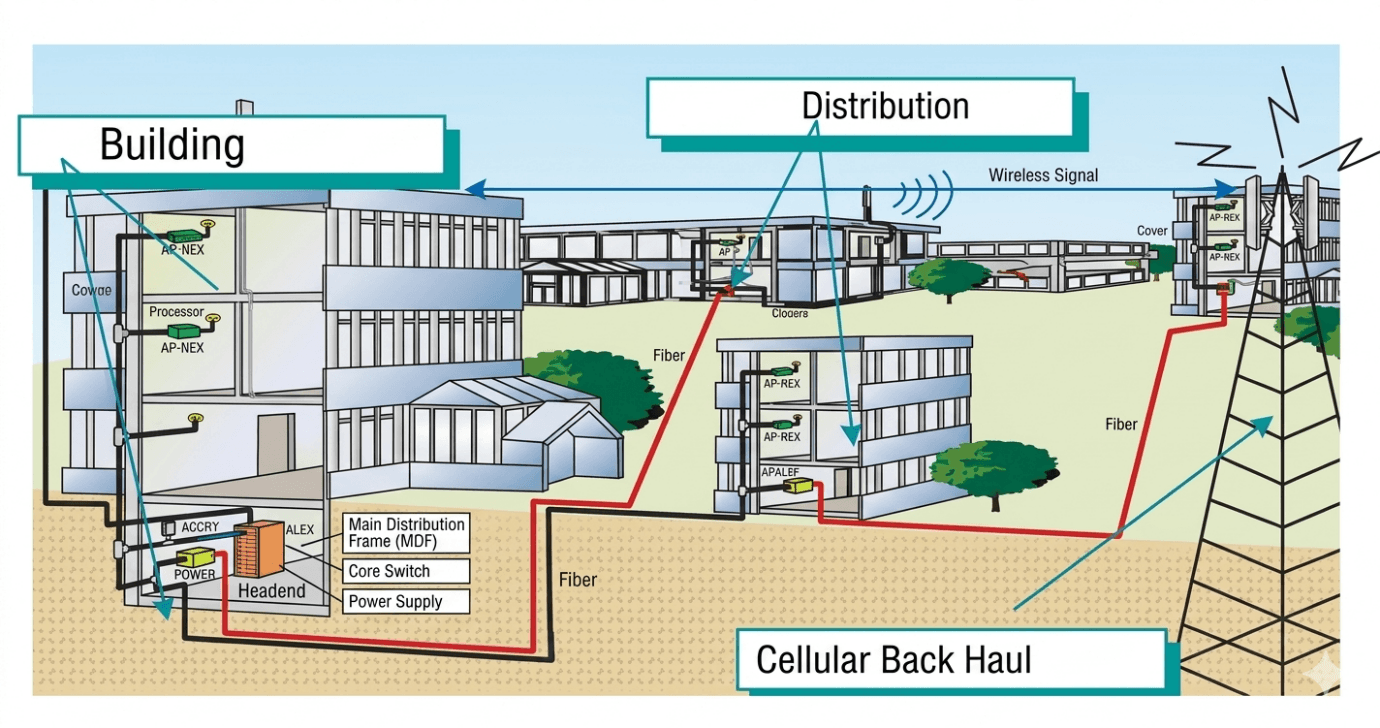
EMTS supplies a complete portfolio of in-building wireless solutions — from a single-band repeater in a small office to a multi-operator, MIMO-capable, 5G-ready Active DAS in a stadium, hospital, or airport.

Active DAS
Best for: Large venues, multi-operator deployments, mission-critical environments, neutral host scenarios.
A fiber-based Master Unit distributes signal to a network of Remote Units throughout the building, supporting any combination of operators, bands, and technologies — including 5G NR — on a single infrastructure.
Key advantages
MIMO-capable for full 5G NR capacity
Neutral Host and Private 4G/5G ready
Scalable: 1 primary hub × 8 secondary hubs × 8 remotes
Web-based NMS with hot-pluggable modules
Typical deployments: Stadiums, airports, hospitals, convention centers, large corporate campuses.
Hybrid DAS
Best for: Medium-to-large buildings combining an active fiber backbone with passive distribution.
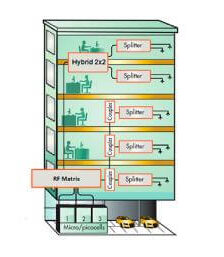
An active fiber core delivers signal to strategic zones; passive components extend coverage to the final antennas. You get Active DAS bandwidth and 5G readiness where it matters, with passive efficiency at the edge.
Key advantages
Lower total cost than full Active DAS
Multi-operator, multi-band, 5G NR support
Future-proof — passive zones can migrate to active as demand grows
Typical deployments: Mid-rise offices, hotels, hospitals, large retail and shopping centers.
Passive DAS
Best for: Small-to-medium buildings, single-operator coverage, lowest CapEx and operational simplicity.
A microcell, repeater, or BDA feeds a network of antennas through passive RF components — no active equipment in the distribution path.
Key advantages
Lowest CapEx and OpEx of any DAS architecture
No active intermodulation, no power or cooling in distribution
Highest long-term reliability
EMTS portfolio: Filters · Diplexers · Duplexers · Hybrids · Splitters · Couplers · 50Ω Loads · Repeaters / BDAs
Typical deployments: Small offices, retail, parking structures, single-floor venues, warehouses.
Repeaters & Bi-Directional Amplifiers
Best for: Targeted coverage, Public Safety code compliance, tunnels, transit, and industrial sites.
A portfolio of cellular repeaters and Public Safety BDAs, with model-dependent output levels from 13 to 43 dBm and gain from 60 to 95 dB. Single-, dual- and tri-band options are available across the range; these are portfolio ranges, not specifications shared by every model.
Supported bands
Low-band 4G/5G NR: 600 / 700 / 800 / 900 MHz (n5, n8, n12, n14, n28, n71)
Mid-band 4G LTE: 1800 / 1900 / 2100 / 2300 / 2500 / 2600 MHz (B1, B2, B3, B7, B40, B41)
5G NR C-band: n77 / n78 (3.3 – 4.2 GHz)
5G NR 2.5 GHz: n41
Legacy 2G/3G band support available on request.
Public Safety portfolio: VHF · UHF / TETRA / LMR (380–470 MHz) · 700/800 MHz Public Safety · TETRA & LMR 800 MHz. Band support depends on the selected model and configuration.
Specialized: Tunnel and underground · Mining · Rail (FRMCS-ready, GSM-R legacy) · Industrial.
Choosing the Right Solution
Building Profile
Recommended Architecture
Small building, single operator, minimal budget
Passive DAS or Repeater / BDA
Medium building, single or dual operator
Passive DAS or Hybrid DAS
Large building, multi-operator, 5G capacity
Hybrid DAS or Active DAS
Stadium, airport, hospital, mission-critical
Active DAS
Multi-operator neutral host
Active DAS
Private 4G/5G enterprise network
Active DAS with private RAN
Targeted weak-signal pocket
Repeater / BDA
Public Safety code compliance
Public Safety BDA
Tunnel, mine, rail, industrial
Specialized Repeater / Fiber ODAS
Send us your building plans, operator requirements, and band list — our engineering team will scope the right solution.
Public Safety / TETRA / DMR DAS Solutions
Reliable RF coverage for first-responder communications.
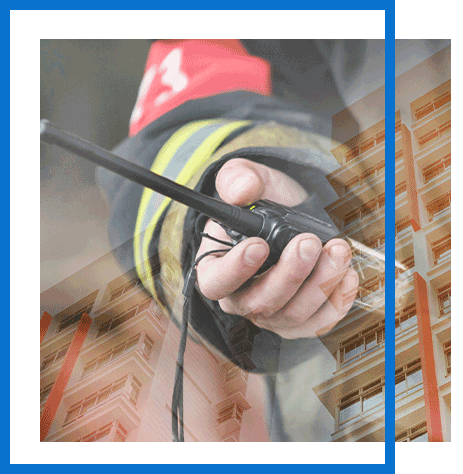
When fire, police, or EMS responders enter a building, their TETRA, DMR, or P25 radios have to work — every floor, every stairwell, every basement. The same construction that blocks cellular signal blocks public safety radio just as effectively, which is why fire and building codes increasingly require in-building public safety coverage as a condition of occupancy.
EMTS engineers, supplies, and supports complete Public Safety / TETRA / DMR coverage solutions — from compact BDA installations in mid-size buildings to multi-floor Fiber DAS deployments in hospitals, transit hubs, and large industrial facilities.
Public Safety BDA
Best for: Small-to-medium buildings, single-band Public Safety / TETRA / DMR coverage, retrofits where rapid deployment matters.
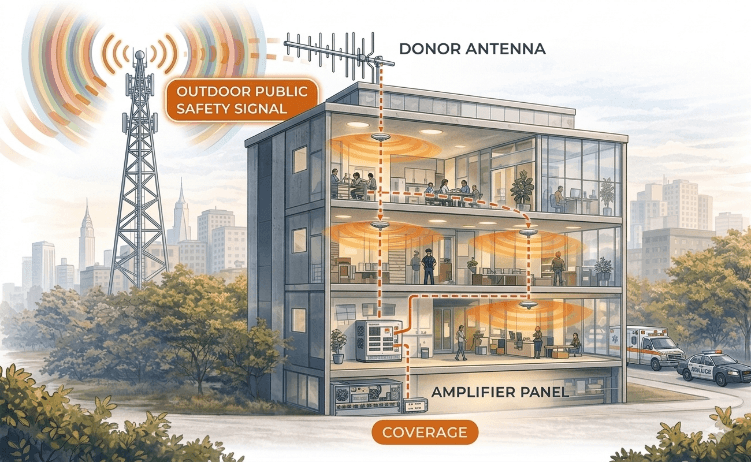
A Public Safety BDA captures the outdoor first-responder signal through a rooftop donor antenna, amplifies it bidirectionally — both downlink and uplink — and redistributes it through a passive antenna network inside the building.
Key advantages
Lower CapEx than fiber-based architectures
Fast to design, install, and certify
Available in Class A (channel-selective) and Class B (band-selective) configurations
Compact NEMA-rated enclosure with FACP alarm integration
Mature, proven technology with long service life
Typical deployments: Mid-size commercial buildings, schools, hotels, mid-rise residential, industrial single-buildings, retail centers.
Public Safety Fiber DAS
Best for: Large buildings, multi-floor towers, sprawling campuses, underground levels, multi-band Public Safety / TETRA / DMR requirements.
A Master Unit at the headend converts the public safety RF signal to optical and distributes it over fiber to a network of Remote Units throughout the building. Each Remote Unit reconverts to RF and radiates locally through compact passive antennas.
The fiber backbone delivers the reach, scalability, and per-zone control that a single BDA cannot — and on the same infrastructure you can carry multiple bands and standards simultaneously: TETRA, DMR, P25, and analog FM where still in use.
Key advantages
Coverage scope a single BDA cannot reach — large floor plates, multiple basements
Fiber runs eliminate the coaxial signal-loss limit
Multi-band, multi-standard, multi-agency on a single infrastructure
Per-Remote-Unit power adjustment for uniform coverage
Centralized monitoring and remote diagnostics via web-based NMS
Future-proof — capacity and band expansion without re-cabling
Typical deployments: Hospitals, airports and transit hubs, stadiums, high-rise commercial and residential towers, convention centers, large industrial campuses, underground parking and metro stations.
Supported Bands & Technologies
VHF Public Safety: 136 – 174 MHz
UHF / TETRA / DMR / LMR: 380 – 470 MHz (TETRA 380-400 MHz, DMR, P25)
700 MHz Public Safety: including FirstNet Band 14
800 MHz Public Safety: TETRA, DMR, LMR, P25
Custom configurations for regional and dedicated frequency plans
Compatible with the major land mobile radio standards: TETRA, DMR, P25 (APCO-25), and analog FM.
Project Compliance Review
Public Safety projects require a review of the applicable code edition, local requirements and the authority having jurisdiction (AHJ). Equipment selection and installation design must be assessed separately from product certification.
- Applicable codes: review NFPA and IFC requirements for the specific project and jurisdiction.
- Product listing: UL 2524 listing must be verified for the exact product; support for an installation requirement does not establish a UL listing.
- Backup power: confirm required runtime and the selected battery configuration.
- Enclosures and cabling: confirm environmental ratings and fire-rated cable requirements.
- Monitoring and alarms: confirm supervision, annunciator integration and oscillation protection for the selected system.
Request model-specific certification and listing documentation, and confirm regional installation requirements with the project engineer and local authority.
Choosing the Right Public Safety Architecture
Project Profile
Recommended Solution
Small-to-medium building, single band, code retrofit
Public Safety BDA
Mid-size building, single agency
Public Safety BDA
Large building, multiple floors, complex layout
Public Safety Fiber DAS
Multi-agency / multi-band (TETRA + DMR + P25)
Public Safety Fiber DAS
Underground levels, parking, basements
Public Safety Fiber DAS
Hospital, airport, mission-critical
Public Safety Fiber DAS (often with cellular DAS overlay)
Existing cellular DAS in place
Public Safety overlay (BDA or Fiber, by size)
Why EMTS for Public Safety / TETRA / DMR
Single-source supplier for BDA, antennas, fiber DAS, and passive components
End-to-end engineering — survey, design, BoM, commissioning, code documentation
Long product lifecycle — public safety projects need vendors who’ll be there in 10 years
Built for demanding conditions — temperature extremes, humidity, continuous duty cycles
Send us your building plans, agency requirements, and applicable code references — our engineering team will scope the right solution
LTE / 5G One Box Network
Private Cellular Connectivity. Configured for Your Deployment.
Some situations can’t wait for infrastructure. A wildfire command post, a disaster zone, a remote mining site, an offshore platform, a naval vessel, an ad-hoc event — all need cellular coverage where there is none, and often need it gone again when the job is done.
EMTS supplies compact, portable, and rapidly deployable LTE and 5G One Box Network solutions — full standalone cellular networks for tactical, private, and emergency use. RAN, core, antennas, and management — in a single transportable enclosure.
LTE / 5G One Box Network
Best for: Emergency response, tactical and military use, disaster recovery, remote sites, private enterprise networks, ad-hoc events, maritime and offshore deployments.
A One Box Network combines radio access, core-network functions and management in a compact deployable system. The supplied components, external dependencies and commissioning steps depend on the proposed configuration. Request a system architecture and bill of materials for your project.
Standalone or connected. Runs completely autonomously with zero backhaul, or connects via satellite, microwave, fiber, or commercial cellular when available — to extend reach, bridge to public networks, or sync with a wider command system.
Key Capabilities
- Confirm LTE/5G modes, spectrum and radio bands for the selected system.
- Identify the RAN, core, SIM provisioning and management components in the project bill of materials.
- Specify required voice, data, video and group-communication services.
- Agree coverage and user capacity targets based on the site, terrain, antennas and spectrum.
- Verify device interoperability, security features and external-network dependencies.
Form Factors
EMTS supports a range of One Box Network form factors to match the mission. All variants are engineered for harsh environments — wide temperature range, shock and vibration tolerance, IP-rated enclosures, and DC/AC power flexibility including battery and solar operation.
Backpack / man-portable — tactical teams, first-on-scene response, special forces
Vehicle-mounted — mobile command centers, fire and rescue vehicles, military convoys
Transit-case — rugged airline-shippable cases for rapid deployment teams
Fixed-site rugged enclosure — private networks at industrial sites, ports, remote facilities
Maritime / shipboard — naval, commercial maritime, offshore platforms
Use Cases
Public Safety & Emergency Response: Disaster recovery when public networks are down, wildfire and flood command posts, mass-casualty events, search and rescue.
Tactical & Defense: Forward operating bases, special operations, border security, coalition interoperability.
Private Enterprise: Mining, oil & gas, construction in greenfield locations, smart agriculture, industrial IoT in remote facilities.
Events & Temporary Coverage: Sporting events, festivals, VIP security, film production in remote locations.
Maritime & Offshore: Naval vessels, commercial shipping, offshore wind farms and oil platforms, port operations.
Choosing the Right Configuration
Mission Profile
Recommended Form Factor
Tactical team, foot-mobile, rapid deployment
Backpack / man-portable One Box Network
Mobile command post, vehicle-borne
Vehicle-mounted One Box Network
Disaster response, airlift-ready
Transit-case One Box Network
Remote private network, fixed site
Fixed-site rugged enclosure
Naval / maritime / offshore
Shipboard / maritime One Box Network
Wide-area coverage required
multi-network clustering / mesh
Mission-critical group communications
One Box Network with MCPTT / MCData / MCVideo
Why EMTS One Box Network
- RF engineering: EMTS designs and manufactures RF coverage products and supports application-specific customization.
- System sourcing: request a project bill of materials identifying EMTS-manufactured equipment, third-party RAN/core software and hardware, antennas, and integration responsibilities.
- Interoperability: confirm supported devices, interfaces and network services for the proposed configuration.
High-Power Linear Amplifiers
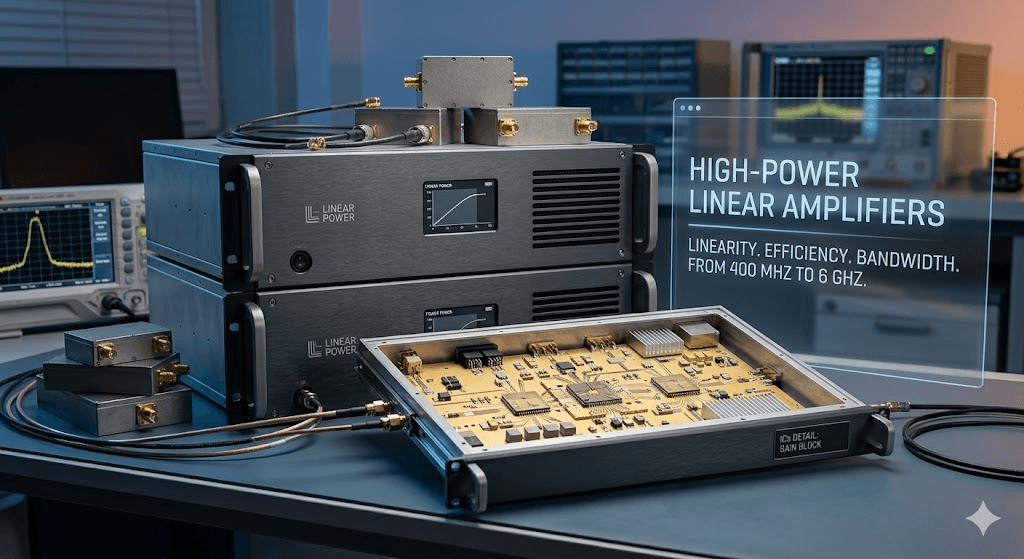
Linearity. Efficiency. Bandwidth. Matched to Your Application.
The transition from 4G LTE to 5G NR has fundamentally raised the bar for RF power amplifiers. Modern waveforms with high peak-to-average power ratios place severe linearity demands on amplifiers, while operators simultaneously demand higher efficiency.
EMTS designs and supplies a complete range of high-power linear amplifiers — engineered to deliver the linearity, efficiency, and bandwidth that today’s 4G LTE and 5G NR networks require.
High-Power Linear Amplifiers
Best for: Cellular base stations, repeater and BDA infrastructure, DAS, broadcast, satellite, defense and tactical systems, test and measurement.
EMTS offers model-specific RF power amplifier configurations for cellular and other wireless applications. Frequency coverage, output power and linearization vary across the portfolio. Use the selected model’s datasheet and agreed measurement conditions when specifying a system.
Frequency Coverage
The catalogue includes amplifiers for cellular and other RF bands. Available frequency bands and air interfaces depend on the model. Confirm the required band plan with EMTS engineering and refer to the product datasheet.
Output power varies by model. The catalogue includes a 200 W configuration; confirm the rated power and operating conditions for your selected model.
Linearization Technologies
Digital Pre-Distortion (DPD)
Digital predistortion compensates for amplifier nonlinearity. Performance depends on the amplifier, waveform, signal bandwidth, output power and operating conditions. Request model-specific ACLR and EVM measurements for the intended LTE or 5G NR configuration.
Feed Forward (FFW)
Proven analog RF linearization, particularly suited to wideband and high-power applications where DPD bandwidth or converter cost becomes prohibitive. Independent of digital baseband — making it ideal for repeater and BDA architectures where DPD is unavailable.
Hybrid Analog + Digital
For demanding applications, EMTS implements combined feed-forward and DPD architectures — leveraging the wideband strength of analog linearization with the precision of digital correction.
Architecture & Device Technology
Doherty Power Amplifier (DPA) — industry-standard for cellular base stations; exceptional efficiency at typical 4G/5G back-off levels
Class AB linear amplifiers — for applications prioritizing maximum linearity and broadband flatness
GaN HEMT (Gallium Nitride) — modern transistor technology for high-power 5G; higher power density and efficiency than LDMOS
LDMOS — proven, cost-effective technology for sub-3 GHz applications
Load Modulated Balanced Amplifier (LMBA) — emerging architecture for very wideband applications
Key Performance Specifications
Parameter
Specification
Frequency range
Model-specific; see product datasheet.
Output power
Model-specific; up to 200 W in the listed portfolio.
Linearization
DPD, Feed Forward, or hybrid
ACLR
Model- and waveform-dependent; request ACLR measurements at the specified output power.
EVM
Confirm EVM for the selected waveform, modulation, bandwidth and output power.
Drain efficiency
Depends on amplifier architecture, output power and operating conditions.
Instantaneous bandwidth
Model-dependent; confirm supported signal bandwidth in the datasheet.
Supported signals
4G LTE, 5G NR (FR1), TETRA, DMR, P25, custom
Architecture
Doherty, Class AB, LMBA
Device technology
GaN HEMT, LDMOS
Open RAN compatible configurations available for O-RU integration.
Use Cases
- Cellular infrastructure — macro, micro, and small cell base stations; 5G Radio Units
- Coverage enhancement — repeater and BDA driver amplifiers for indoor and outdoor DAS
- Public Safety & Tactical — TETRA, DMR, P25, dedicated tactical networks
- Private LTE / 5G — One Box Network, industrial private networks, mining and offshore
- Defense & Government — communications, jamming, electronic warfare systems
- Broadcast & Satcom — DTV, DAB, FM transmission; ground station uplinks
- Test & Measurement — high-power signal generation for lab and production test
Why EMTS Linear Amplifiers
In-house RF engineering — design, integration, and test under one roof
Modular architecture — power, band, and linearization configured to application
Latest device technology — GaN-based designs for 5G; LDMOS where cost-optimal
Custom designs welcome — frequency, power, form factor, and interfaces tailored to project
Long product lifecycle — supporting deployments over 10+ year operational lifetimes
Drone Detection and Elimination Tactical Solutions
Complete Airspace Security
Tactical Counter-UAS (C-UAS) Solutions: Complete Airspace Security
Advanced, Multi-Layered Defense Systems Against Unmanned Aerial Threats
Early Detection & Multi-Sensor Tracking
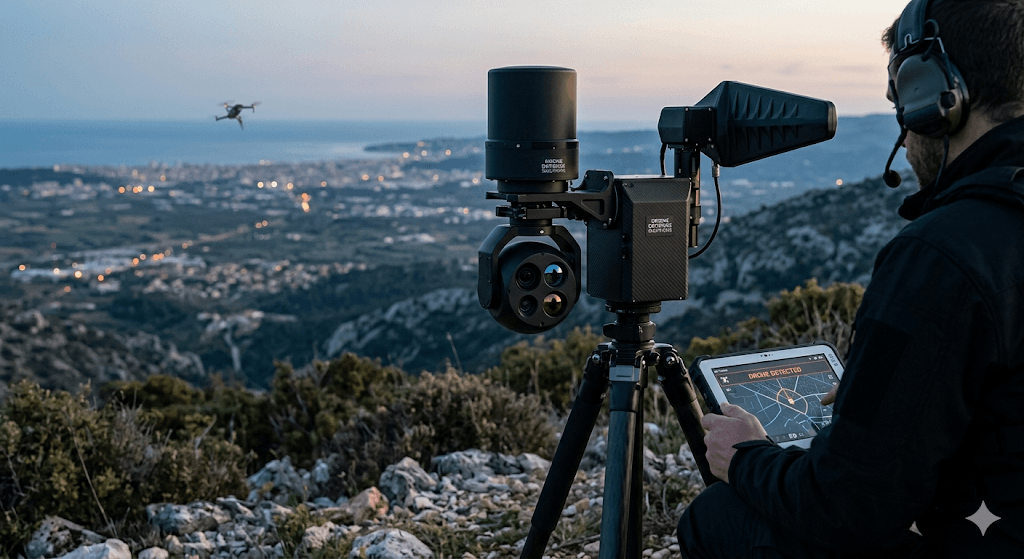
- Our tactical systems integrate advanced RF scanning, compact radar, and electro-optical (EO/IR) sensors to detect unauthorized drones at long ranges.
- Real-time tracking provides immediate classification of the threat type, flight path, and telemetry data.
SDR-Based Technological Agility
- Built on high-performance Software-Defined Radio (SDR) architectures to quickly adapt to new frequencies and evolving drone communication protocols.
- This core flexibility ensures long-term operational relevance against custom-built, modified, or next-generation threats.
Precision Electronic Mitigation
- Detection and tracking are distinct from RF mitigation. Mitigation capabilities, operating constraints and effects on surrounding communications must be confirmed for the specific system and deployment. Contact EMTS to discuss the available configuration.
Unified Command & Control (C2) Interface
- Aggregates data from all distributed sensors into a single, highly intuitive graphical user interface (GUI) for real-time situational awareness.
- The system provides clear automated alerts and recommends optimal mitigation strategies for fast decision-making.
Rapid Deployment & High Mobility
- Engineered specifically for fluid field operations, the tactical kits can be fully deployed and operational within minutes.
- Available in versatile configurations, including rugged tripod setups, vehicle-mounted systems, or lightweight man-pack kits for mobile teams.
Critical Infrastructure & Event Protection
- Creates a secure, invisible defensive dome over power stations, airports, military perimeters, and large-scale public venues.
- Designed for continuous, automated 24/7 autonomous monitoring in dense RF or harsh outdoor environments.
Seamless System Integration
- Built with an open-architecture framework to easily integrate with existing physical security systems, IP cameras, and local command networks.
- Allows operators to scale their defense ecosystem by seamlessly adding new sensory hardware or disruption capabilities as requirements grow.