Fiber DAS Systems for Cellular and Mission-Critical Coverage
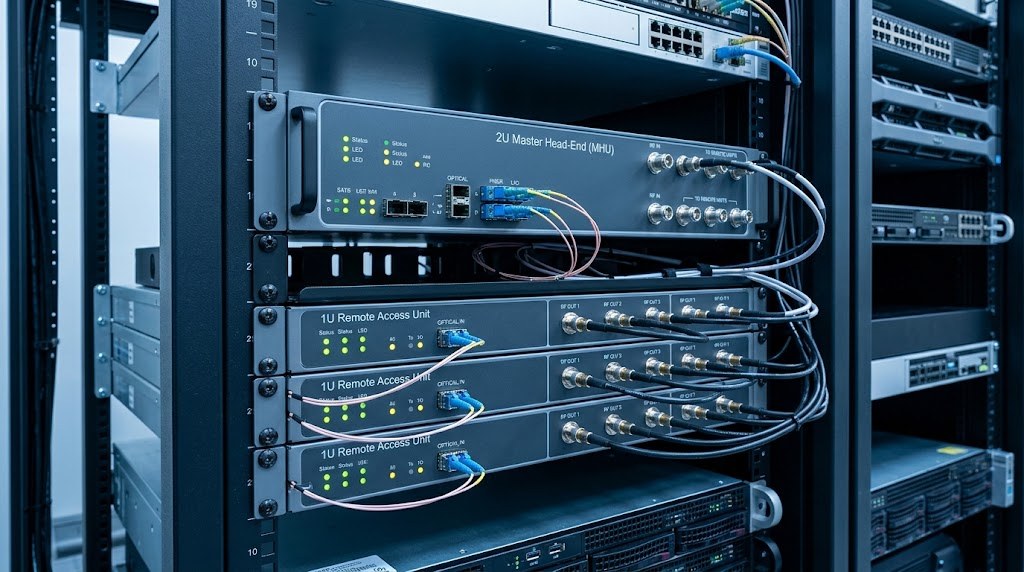
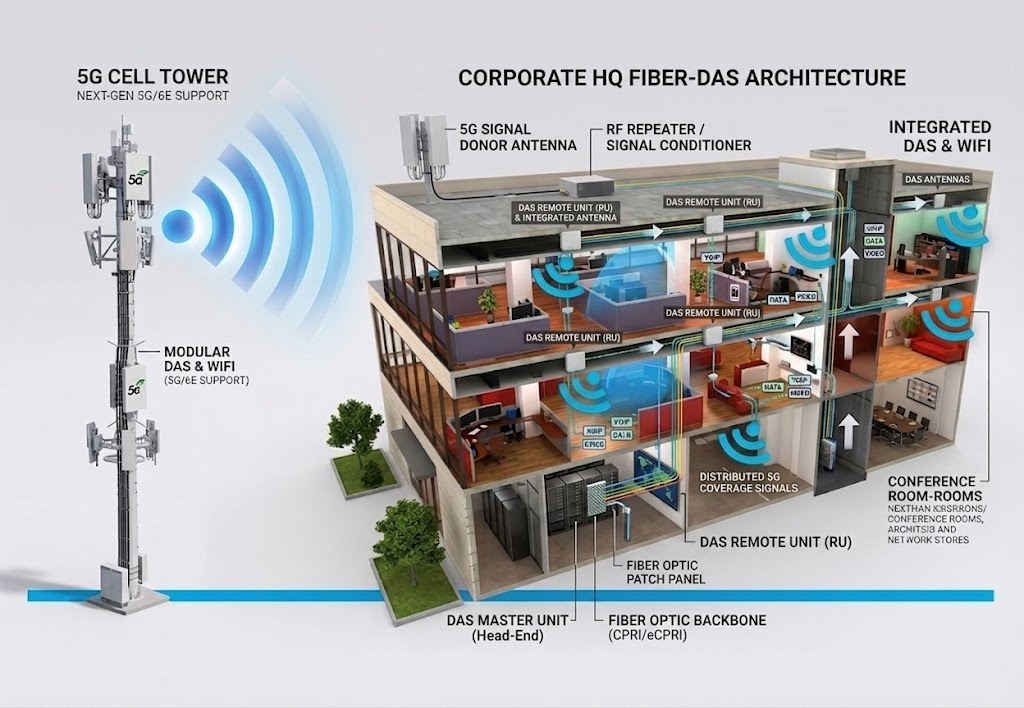
Fiber DAS systems distribute radio signals over optical fiber from a central headend to remote units installed where coverage is needed. First, a master unit (MU) connects to the signal source, such as a base station, a point of interface (POI) or an off-air repeater, and converts the RF signal to optical. Then, remote units (RU) convert it back to RF and feed local antennas. Because optical fiber has far lower loss than coaxial cable over long runs, a distributed antenna system (DAS) built on fiber can serve large buildings, campuses, tunnels and underground sites.
EMTS offers fiber DAS systems in two product groups: one for cellular networks and one for mission-critical radio.
Cellular fiber DAS systems, 2G to 5G
The cellular fiber DAS group includes master units and dual, tri and quad band remote units for combinations of 900, 1800, 2100 and 2600 MHz. For example, low power MIMO remote units are rated around 23 dBm, while high power remote units reach up to 43 dBm. In addition, multi-band systems for private 4G and 5G networks are available, with configurations for Band 31, Band 26, n78 and n79. For 5G NR n78 with 4×4 MIMO, see the 5G fiber DAS group.
Mission-critical fiber DAS for TETRA, DMR and P25
The mission-critical fiber DAS group covers VHF, 400 MHz and 800 MHz systems for TETRA, DMR, P25 and analog land mobile radio. Specifically, it includes master units, high power fiber remote units, fiber optic repeating systems and pickup repeaters in 19 inch enclosures that bring an off-air signal into the system.
When to choose fiber DAS instead of a repeater
An off-air cellular RF repeater is often enough for a single area with a usable donor signal. However, fiber DAS systems become the better choice when the site is large, has many floors or underground levels, needs several operators or radio services on one infrastructure, or requires cable runs that coaxial cable cannot support without excessive loss. For a detailed comparison, read Fiber DAS vs. RF Repeaters: Choosing an In-Building Coverage Solution.
Information needed to design a fiber DAS
- Floor plans or site maps, and the areas that require coverage
- Operators, bands and technologies, including any public safety services
- Signal source: base station, POI or off-air donor
- Required MIMO configuration and capacity
- Fiber routes, power availability and monitoring needs
Frequently asked questions about fiber DAS
What is the difference between a master unit and a remote unit?
The master unit sits at the headend and interfaces with the signal source. In contrast, remote units are installed in the coverage area and connect to the antennas. One master unit can serve several remote units, depending on the model.
Can one fiber DAS carry cellular and public safety signals?
EMTS offers cellular and mission-critical fiber DAS as separate product groups. Therefore, a combined design depends on the bands and equipment involved, so it should be reviewed with our engineers.
Contact EMTS with your site details to discuss a fiber DAS design.