Advanced RF Systems. Engineered for Real-World Connectivity.
EMTS Telecom Services designs and manufactures RF coverage and communication solutions for mobile network operators, public safety, mission-critical communications and system integrators worldwide.
From cellular repeaters and fiber DAS to high-linearity power amplifiers, passive RF components and private LTE/5G systems, we combine in-house engineering, manufacturing expertise and application-specific customization.

Cellular RF Repeaters for Indoor and Outdoor Coverage
Cellular RF repeaters extend mobile coverage into places the macro network does not reach well, such as basements, tunnels, industrial sites, rural roads and large buildings. In practice, a repeater receives the downlink signal from a donor base station through a donor antenna, amplifies it and retransmits it through service antennas. At the same time, it amplifies the uplink signal from mobile devices back to the network.
EMTS designs and manufactures cellular RF repeaters for 2G, 3G, 4G LTE and 5G NR networks. The range is organised by the number of supported bands, so you can start from the configuration that matches your operator and spectrum plan.
Single, dual, triple and quad band cellular RF repeaters
Single band RF repeaters cover one frequency band, from Band 31 (450 MHz) up to n79 (4500 MHz). Dual band RF repeaters combine two services in one unit, for example Band 3 with n78. Triple band and quad band models serve sites that need several bands from one platform.
Output power and repeater type
Output power in the range starts with compact pico and mini repeaters at 13 to 24 dBm. In the middle of the range, power repeaters typically deliver around 30 to 33 dBm. Finally, high power models are rated up to 43 dBm. However, exact output power, gain and supported channels are model specific and are listed in each datasheet.
Band selective repeaters amplify a complete band. In contrast, digital repeaters use software defined filters to select sub bands or operators. An interference cancellation system (ICS) reduces feedback between the donor and service antennas, which can ease antenna isolation requirements. In addition, TDD models are available for bands such as Band 40, Band 41 and n78.
How to select a cellular repeater
Before selecting a model, collect the following information:
- Operators, frequency bands and technologies to be covered
- Donor signal level at the planned donor antenna location
- Size and type of the coverage area, indoor or outdoor
- Available isolation between the donor and service antennas
- Power supply, mounting and remote monitoring requirements
However, for large multi-operator buildings, a fiber DAS system may be a better fit than an off-air repeater. Our guide Fiber DAS vs. RF Repeaters compares both approaches. For 5G NR projects, see our 5G coverage solutions.
Frequently asked questions about cellular RF repeaters
Do EMTS repeaters support 5G?
Yes, several models do. The range includes n78 and n79 repeaters and dual band 4G/5G units. However, 5G support depends on the specific model.
Can one repeater serve several operators?
Digital repeaters with multiple software defined filters can amplify selected carriers of more than one operator in the same band. However, this depends on the model and on approval from the network operators.
Can the repeaters be installed outdoors?
Many models are specified for indoor or outdoor installation with an IP65 rated enclosure. Even so, always check the environmental rating in the datasheet of the selected model.
Need help choosing? Contact the EMTS engineering team with your band list and site details.
5G Coverage Solutions for Indoor and Outdoor NR Networks
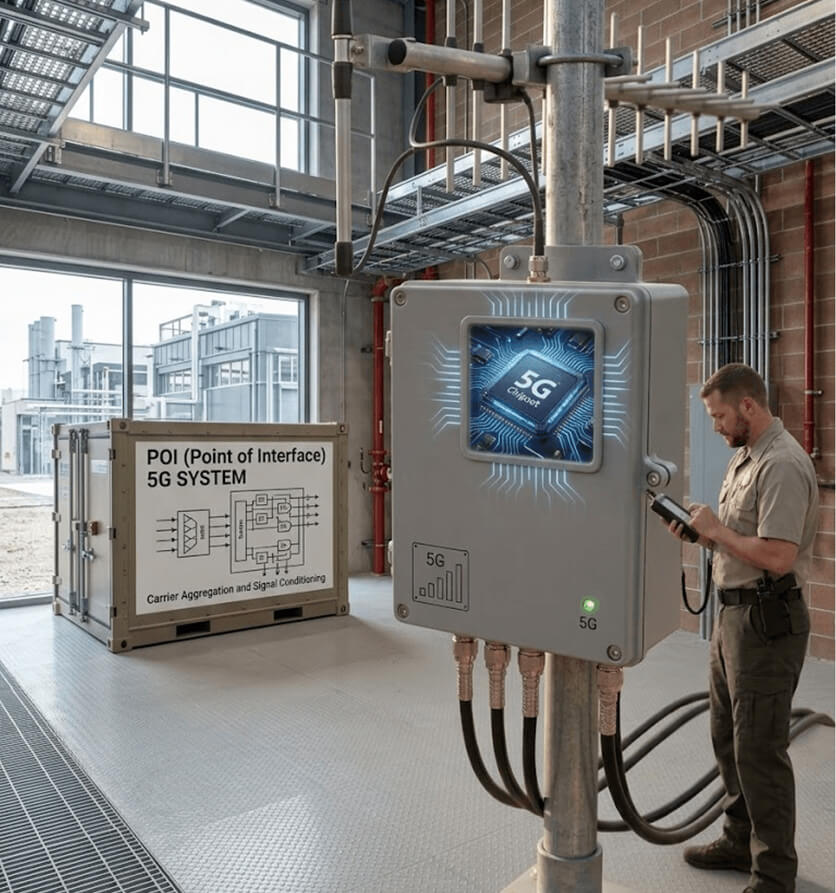
5G coverage solutions help operators, neutral host providers and system integrators bring 5G NR service indoors. They also serve other areas where the mid-band signal is weak. However, signals at 3.5 GHz and 4.5 GHz lose more energy through walls and coated glass than lower bands. As a result, indoor 5G often needs dedicated equipment rather than outdoor cells alone.
EMTS supplies the RF building blocks for these projects, from off-air repeaters to multi-operator distribution equipment.
5G NR repeaters
The 5G repeaters group includes n78 repeaters from 24 dBm to 40 dBm and n79 models at 20 dBm and 33 dBm. It also offers dual band 4G/5G repeaters that pair n78 with Band 1, Band 3 or Band 41. In addition, the group includes a quad band mini repeater and an n78 in-line booster. Also, because n78 and n79 are TDD bands, a 5G repeater has to follow the uplink and downlink timing of the network.
5G fiber DAS
For larger venues, the 5G fiber DAS system for n78 TDD consists of a master unit, an extension unit and remote units that support 4x4 MIMO. In this way, a fiber backbone carries the signal to remote units close to users, which helps to keep coverage consistent across floors.
Multi-operator 5G coverage solutions: POI, matrix and attenuator
When several operators share one DAS, a point of interface (POI) combines their base station signals before distribution. For example, EMTS POI modules cover ranges such as 617 to 4200 MHz and 700 to 3800 MHz. One model provides four outputs for a 4x4 MIMO DAS. RF hybrid matrices for 600 to 4100 MHz combine and split signals between base stations and DAS branches. Finally, the 100 W, 40 dB attenuator box can reduce high power base station signals to suitable levels at the headend.
5G NR bands covered
- n77: 3300 to 4200 MHz
- n78: 3300 to 3800 MHz
- n79: 4400 to 5000 MHz
However, supported bands, power levels and MIMO options differ between products. Check each datasheet, or ask EMTS to review your band plan. For 5G power stages, see our 5G NR power amplifiers.
Frequently asked questions about 5G coverage
Should I use a 5G repeater or a 5G fiber DAS?
In short, a repeater suits a defined area that receives a usable outdoor 5G signal. In contrast, a fiber DAS suits large or multi-operator buildings that need capacity, MIMO and a signal source such as a base station connected through a POI.
Can 4G and 5G be combined?
Yes. Dual band repeaters combine an LTE band with n78, and EMTS POI modules accept both 4G and 5G base station signals.
Talk to an EMTS engineer about your 5G coverage project.

High-Linearity RF Power Amplifiers for LTE and 5G NR
High-linearity RF power amplifiers raise the power of a radio signal while keeping distortion low. Linearity matters because LTE and 5G NR use waveforms with a high peak to average power ratio. As a result, an amplifier that compresses these peaks creates adjacent channel leakage and degrades modulation quality, which is measured as ACLR and EVM.
EMTS designs multi-carrier power amplifiers (MCPA) for repeaters, DAS, base station and special purpose systems. Because a multi-carrier amplifier handles several carriers in the same band at once, it has to stay linear across its full operating bandwidth.
Amplifier groups
4G LTE power amplifiers cover bands from 450 MHz to 2.7 GHz, including FDD bands and Band 40/41 TDD, with most models rated between 5 W and 50 W. 5G NR power amplifiers cover n77, n78 and n79 between 3.3 GHz and 5 GHz at 10 W or 20 W. In addition, the wide-band and custom group includes a 617 to 821 MHz amplifier rated at 200 W and a UHF multi-carrier amplifier.
How to compare high-linearity RF power amplifiers
In other words, rated output power is only one part of the picture. Key parameters include:
- Frequency range and instantaneous bandwidth
- Rated average output power for the intended signal
- ACLR and EVM under the specified test conditions
- Gain, gain flatness and noise figure
- Efficiency, cooling and power supply
- FDD or TDD operation and switching requirements
Values such as ACLR and EVM depend on the waveform, carrier bandwidth, output power and whether digital pre-distortion (DPD) is used. For this reason, compare datasheet figures only when they were measured under the same conditions.
Typical applications
Typical applications include power stages for cellular RF repeaters and fiber DAS systems, base station and small cell equipment, and private or mission-critical networks. For 5G NR distribution components such as POI modules and RF matrices, see 5G coverage solutions.
Frequently asked questions about RF power amplifiers
What is an MCPA?
A multi-carrier power amplifier amplifies several carriers at the same time within its band. As a result, it replaces separate single carrier amplifiers and needs high linearity to limit intermodulation between the carriers.
Do the amplifiers support TDD?
Yes, selected models do. The 2.5 GHz models are specified for Band 40 and Band 41 TDD, and the 5G NR models serve TDD bands such as n77, n78 and n79. Even so, check the datasheet for switching requirements.
Can EMTS build an amplifier for a non-standard band?
Custom frequency, output power and form factor options are available on request. Send your requirements to our engineers to confirm feasibility.
Contact EMTS to discuss the right amplifier for your system.
Fiber DAS Systems for Cellular and Mission-Critical Coverage
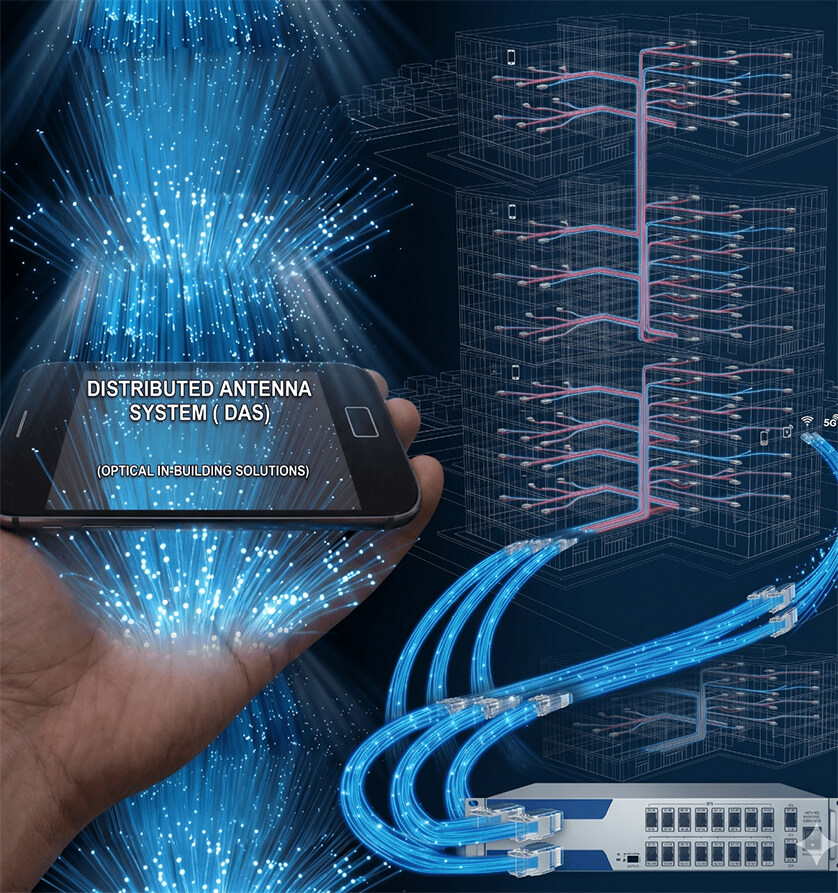
Fiber DAS systems distribute radio signals over optical fiber from a central headend to remote units installed where coverage is needed. First, a master unit (MU) connects to the signal source, such as a base station, a point of interface (POI) or an off-air repeater, and converts the RF signal to optical. Then, remote units (RU) convert it back to RF and feed local antennas. Because optical fiber has far lower loss than coaxial cable over long runs, a distributed antenna system (DAS) built on fiber can serve large buildings, campuses, tunnels and underground sites.
EMTS offers fiber DAS systems in two product groups: one for cellular networks and one for mission-critical radio.
Cellular fiber DAS systems, 2G to 5G
The cellular fiber DAS group includes master units and dual, tri and quad band remote units for combinations of 900, 1800, 2100 and 2600 MHz. For example, low power MIMO remote units are rated around 23 dBm, while high power remote units reach up to 43 dBm. In addition, multi-band systems for private 4G and 5G networks are available, with configurations for Band 31, Band 26, n78 and n79. For 5G NR n78 with 4x4 MIMO, see the 5G fiber DAS group.
Mission-critical fiber DAS for TETRA, DMR and P25
The mission-critical fiber DAS group covers VHF, 400 MHz and 800 MHz systems for TETRA, DMR, P25 and analog land mobile radio. Specifically, it includes master units, high power fiber remote units, fiber optic repeating systems and pickup repeaters in 19 inch enclosures that bring an off-air signal into the system.
When to choose fiber DAS instead of a repeater
An off-air cellular RF repeater is often enough for a single area with a usable donor signal. However, fiber DAS systems become the better choice when the site is large, has many floors or underground levels, needs several operators or radio services on one infrastructure, or requires cable runs that coaxial cable cannot support without excessive loss. For a detailed comparison, read Fiber DAS vs. RF Repeaters: Choosing an In-Building Coverage Solution.
Information needed to design a fiber DAS
- Floor plans or site maps, and the areas that require coverage
- Operators, bands and technologies, including any public safety services
- Signal source: base station, POI or off-air donor
- Required MIMO configuration and capacity
- Fiber routes, power availability and monitoring needs
Frequently asked questions about fiber DAS
What is the difference between a master unit and a remote unit?
The master unit sits at the headend and interfaces with the signal source. In contrast, remote units are installed in the coverage area and connect to the antennas. One master unit can serve several remote units, depending on the model.
Can one fiber DAS carry cellular and public safety signals?
EMTS offers cellular and mission-critical fiber DAS as separate product groups. Therefore, a combined design depends on the bands and equipment involved, so it should be reviewed with our engineers.
Contact EMTS with your site details to discuss a fiber DAS design.

TETRA and DMR Coverage Solutions for Mission-Critical Networks
TETRA and DMR coverage solutions keep professional radio users connected inside buildings, tunnels, stations and industrial sites that the outdoor network cannot reach. For example, police, fire and ambulance services, transport operators and utilities rely on these radios for voice and data, so in-building coverage needs the same careful planning as the outdoor network.
EMTS develops bi-directional amplifiers (BDA), off-air repeaters, in-line boosters and fiber DAS for TETRA, DMR, P25 and analog land mobile radio (LMR) systems. The product groups below are organised by frequency band.
TETRA and DMR product groups by band
- VHF: band selective and channel selective BDAs, an in-line booster and a VHF fiber remote unit
- TETRA, DMR and P25 400 MHz: repeaters, BDAs in 19 inch enclosures, in-line boosters, and fiber DAS master and remote units
- TETRA and DMR 800 MHz: band selective BDAs, a tunable bandwidth high power repeater, in-line boosters and fiber DAS
- DMR 700 to 800 MHz: dual band 700/800 MHz repeaters from 20 dBm to 40 dBm and a fiber remote unit
- LTE for mission-critical applications: band and channel selective LTE repeaters and in-line boosters
- GSM-R: band selective and channel selective repeaters for railway networks
BDA, in-line booster or fiber DAS?
A band selective BDA amplifies a whole frequency band and suits smaller buildings or sites with a single radio system. In contrast, a channel selective BDA filters individual channels, which helps where several networks operate close together and only specific channels should be amplified. Meanwhile, in-line boosters compensate for cable and splitter losses inside an existing distribution system or tunnel.
However, for large or multi-level sites, a mission-critical fiber DAS distributes the signal from a master unit to remote units over optical fiber and avoids the loss of long coaxial runs.
What to prepare for a TETRA or DMR coverage project
- Radio standard and the exact frequencies or channel list
- Donor site location and received signal level
- Coverage areas, including stairwells, basements and tunnels
- Applicable codes and requirements of the authority having jurisdiction
- Backup power, alarm and monitoring requirements
In addition, product listings and certifications must be confirmed for each specific model and project. For a step-by-step planning guide, read TETRA and DMR Coverage: Planning Reliable In-Building Communications.
Frequently asked questions about TETRA and DMR coverage
Do EMTS products support P25?
Several 400 MHz, 700/800 MHz and VHF products are specified for P25 as well as TETRA, DMR and analog systems. Even so, check the datasheet of the selected model.
What is the difference between a repeater and a BDA?
In professional radio the terms are often used interchangeably. In both cases, the equipment amplifies the downlink and uplink signals between a donor site and the coverage area.
Contact EMTS to plan reliable mission-critical radio coverage.
Counter-UAS Detection and Private LTE Networks
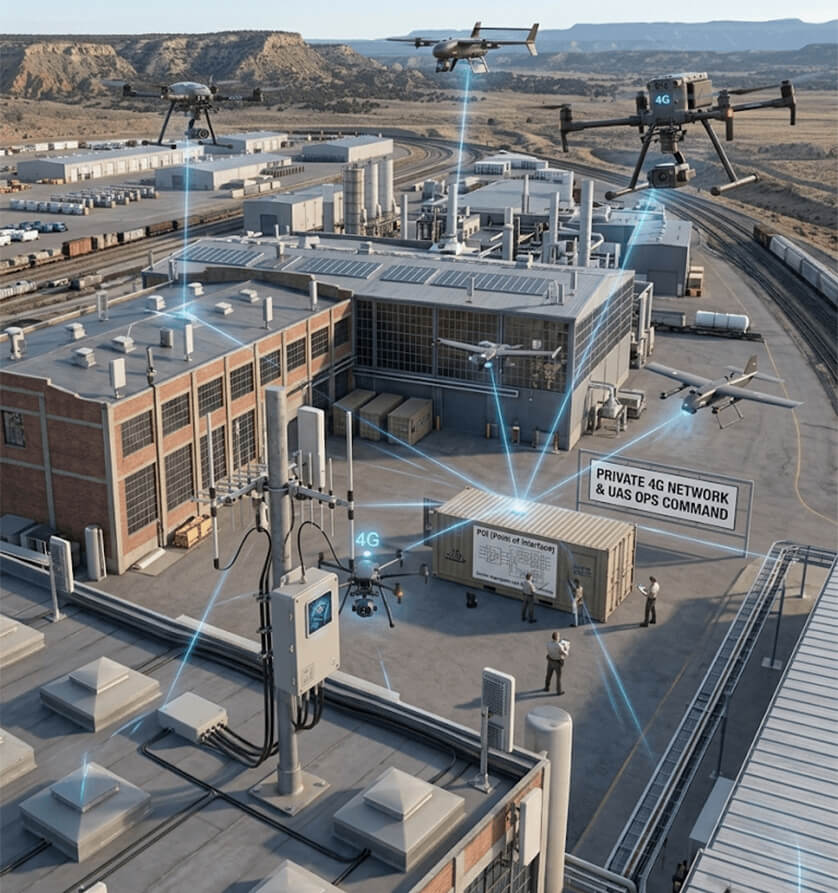
This category brings together two separate solution areas for security, defense and critical infrastructure customers: counter-UAS detection systems that identify and track drone activity, and private LTE networks that give field teams independent communications. However, they solve different problems and are specified separately, even when both are deployed at the same site.
Counter-UAS detection systems
Counter-UAS detection, often shortened to C-UAS detection, is the first layer of any drone defense concept. In other words, before a response can be decided, the operator needs to know that a drone is present, where it is and how it is controlled.
The drone defense group includes the MS-CUAS-360 detection and situational awareness system, which combines passive RF detection, LTE/5G network monitoring and acoustic arrays. In addition, it includes a multi-sensor counter-UAS detection reference design for distributed sensor networks.
Detection and tracking are distinct from RF mitigation. Therefore, any mitigation capability, its operating constraints and its legal authorisation must be confirmed for the specific system, country and deployment.
Private LTE networks for field operations
A private LTE network gives a team its own cellular coverage, independent of public operators. The private 4G and 5G networks group includes the Patron-P10, a compact, rapidly deployable TD-LTE command and communication system designed to establish an independent LTE network for first responders and command centers.
Integrated tactical RF solutions
The integrated tactical RF group covers RF building blocks for tactical and private network projects, including in-line amplifiers for LTE 1800 MHz and for 400 MHz DMR and TETRA systems.
What to define before a counter-UAS detection or private network project
- Protected area, sensor locations and required detection coverage
- Drone types and control links of concern
- Integration with existing security and command systems
- For private LTE: spectrum, coverage area, number of users and services
- Power, mobility and environmental conditions
Frequently asked questions
Does a detection system also stop drones?
No. Detection identifies and tracks drone activity. Instead, mitigation is a separate capability that depends on the system, on local regulations and on authorisation.
Can a private LTE network operate without public infrastructure?
Rapidly deployable systems such as the Patron-P10 are designed to establish an independent LTE network. However, backhaul and integration options depend on the configuration.
For related coverage equipment, see our TETRA and DMR coverage solutions, or contact EMTS to discuss your requirements.

Who We Are
About EMTS Telecom Services
Our Solutions
We offer a wide range of RF communication devices and systems.
Each solution is engineered to meet the demanding standards of modern communication networks, ensuring reliability, scalability, and seamless integration.
Why Work With EMTS Telecom
Let us change the way you think about technology
Not a startup. Not a generalist. EMTS has been engineering and manufacturing RF coverage equipment for 20+ years, evolving the portfolio across every cellular generation and across every major critical-communications standard.
Cellular (4G LTE + 5G NR) + DAS + Public Safety + TETRA / DMR + GSM-R + RF modules. This breadth matters when projects involve mixed-technology coverage requirements that single-product vendors cannot address.
High-volume production capability paired with a dedicated low-volume "Build-to-Spec" line. From custom band plans to non-standard form factors and unique RF chain requirements — we engineer it, we build it, we deliver it.
Linearity, isolation, interference cancellation, out-of-band rejection and noise figure are designed in from the first schematic. The difference between equipment that passes acceptance testing and equipment that performs in the field over years.
Active customers and projects across EMEA, the Americas, Africa, Asia-Pacific and the CIS region — supported by direct customer access to our engineering teams, not a layered support hierarchy.

RF Coverage Solutions for Operators, Integrators and Mission-Critical Networks
RF coverage solutions close the gap between where a wireless network is built and where people actually need a signal. Typical examples are deep inside buildings, underground levels, railways and roads, and remote industrial sites. EMTS Telecom Services designs and manufactures the equipment behind these solutions, from compact repeaters to fiber distributed antenna systems and high power amplifiers.
One portfolio for cellular and professional radio
Our product families cover 2G, 3G, 4G LTE and 5G NR cellular networks. In addition, they support TETRA, DMR, P25 and other land mobile radio systems. As a result, mixed-technology projects can be planned with one supplier. Explore the main families:
- Cellular RF repeaters for single, dual, triple and quad band coverage
- Fiber DAS systems for large buildings, campuses and tunnels
- High-linearity RF power amplifiers for LTE and 5G NR
- 5G coverage solutions, including NR repeaters, POI modules and RF matrices
- TETRA and DMR coverage solutions for public safety and transport
- Counter-UAS detection and private LTE networks
How we plan RF coverage solutions
Every project starts with the site and the services that must work there. First, our engineers review the bands and operators involved and the available donor signal or signal source. Next, they look at the size and construction of the coverage area, together with requirements such as monitoring, backup power or public safety codes. Based on this review, we recommend an off-air repeater, a bi-directional amplifier, a fiber DAS or a combination of these.
Standard products and build-to-spec designs
Alongside the standard catalogue, EMTS runs a dedicated low-volume line for build-to-spec products. For example, this covers custom band plans, non-standard form factors and specific RF chain requirements. Because R&D and manufacturing take place in-house in Israel, designs can be adapted while you keep direct contact with the engineers who build them.
Frequently asked questions
Who uses EMTS RF coverage solutions?
Our customers include mobile network operators, system integrators, public safety agencies and enterprise customers. Projects run across EMEA, the Americas, Africa, Asia-Pacific and the CIS region.
Where can I find technical specifications?
Each product page lists key features and specifications and offers a downloadable datasheet. For project-specific values, contact our engineering team.
Let’s Talk Solutions
Elevating Businesses through Strategic Technology Solutions
Whether you’re specifying a project, selecting equipment, or seeking technical guidance, our team is ready to support your wireless communication needs and provide a tailored quote.
Contact us for additional information!
HIGH END RF COVERAGE SOLUTIONS