
TETRA and DMR in-building coverage keeps professional radio users connected where the outdoor network fades: in basements, stairwells, tunnels, car parks and large industrial halls. In short, reliable coverage comes from a structured process. First survey the site, then define the radio requirements, select a bi-directional amplifier (BDA) or a fiber DAS, design for the applicable codes, and finally verify performance at commissioning. This article walks through each step.
Why TETRA and DMR in-building coverage needs dedicated planning
TETRA (Terrestrial Trunked Radio) is an ETSI standard family (EN 300 392) widely used by public safety organisations. DMR (Digital Mobile Radio), defined in ETSI TS 102 361, is popular with utilities, transport operators, industry and public safety users. Both typically operate in VHF or UHF bands, and modern construction materials attenuate these signals just as they attenuate cellular signals.
Unlike cellular coverage, mission-critical radio coverage is often a safety requirement. In the United States, for example, NFPA 1225 (2022 edition), Chapter 18 sets requirements for in-building emergency responder communication enhancement systems. These include 99 percent floor area coverage in critical areas, 95 percent in general building areas and a minimum delivered audio quality (DAQ) of 3.0. However, adopted code editions and local rules vary, so the authority having jurisdiction (AHJ) decides what applies to each project.
Step 1: Survey the site and the donor signal
Start with measurements. Record the outdoor signal level from the serving radio site and choose a donor antenna position with a clear path towards it. Next, measure indoor signal levels floor by floor and mark the areas where radios fail. Pay special attention to critical areas such as fire command centres, stairwells, elevator lobbies, pump rooms and underground levels.
Step 2: Define the radio requirements
Coverage design depends on accurate radio data. Before selecting equipment, confirm:
- The radio standard: TETRA, DMR, P25 or analog
- The frequency band, for example VHF, UHF 400 MHz or 700/800 MHz
- The exact channel list for downlink and uplink
- How many networks or agencies must be supported
- Any requirement to keep neighbouring networks out of the system
Step 3: Choose between a BDA and a fiber DAS
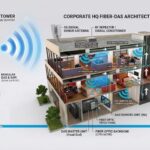
For small and mid-size buildings, a BDA connected to a passive antenna network is often enough. For large, multi-level or multi-agency sites, a fiber DAS distributes the signal from a master unit to remote units over optical fiber and avoids the loss of long coaxial runs. In tunnels and long corridors, in-line boosters can compensate for cable and splitter losses in an existing distribution system.
Band selective or channel selective BDA
A band selective BDA amplifies a complete frequency band. This is simple and suits sites served by a single network. A channel selective BDA, by contrast, amplifies only the programmed channels, which helps where other networks operate on nearby frequencies.
EMTS offers TETRA and DMR coverage solutions by band, including VHF, TETRA, DMR and P25 400 MHz and 800 MHz products, as well as mission-critical fiber DAS.
Step 4: Design for codes, backup power and monitoring
Public safety systems are usually expected to keep working during a power failure. NFPA 1225 (2022), for example, calls for 12 hours of full system operation from the secondary power source in its standard configurations. In addition, plan system monitoring and alarm outputs, environmental ratings for each enclosure, and oscillation protection. Where a UL listing is required, such as UL 2524, it must be verified for the exact product, because support for an installation requirement does not by itself establish a listing.
Step 5: Commission and verify
After installation, test the system against the design and the code requirements. Typically, this includes grid testing on each floor, DAQ checks with real radios, and confirmation that both downlink and uplink work in critical areas. Finally, document the results for the AHJ and the network operator, and schedule the periodic tests that the local rules require.
Common mistakes to avoid
- Designing only for downlink and ignoring uplink performance
- Adding uplink noise that affects the outdoor radio site
- Insufficient isolation between donor and indoor antennas
- Forgetting stairwells, elevators and underground levels
- Installing without coordination with the licensee of the radio network
Many buildings also need cellular coverage. If so, read our comparison of fiber DAS vs RF repeaters to plan both systems together.
Frequently asked questions
Can one system cover TETRA and DMR at the same time?
It depends on the frequencies. If both networks use the same band, one band selective or multi-channel system may cover both. Different bands need equipment for each band, often combined on a shared fiber DAS. Review the channel plan with an engineer.
What is the difference between a band selective and a channel selective BDA?
A band selective BDA amplifies an entire frequency band. A channel selective BDA amplifies only selected channels, which avoids amplifying neighbouring networks.
Do I need permission from the radio network operator?
Yes. A BDA retransmits the licensee’s frequencies, so coordination with the network operator, and in many places with the AHJ, is required.
How long must backup power last?
It depends on the applicable code. For example, NFPA 1225 (2022) calls for 12 hours of full system operation in its standard configurations, while local rules may differ.
Do EMTS products also support P25?
Several EMTS 400 MHz, 700/800 MHz and VHF products are specified for P25 in addition to TETRA, DMR and analog radio. Check the datasheet of each model.
Planning mission-critical radio coverage? Contact EMTS with your channel list, floor plans and code requirements for a project recommendation.