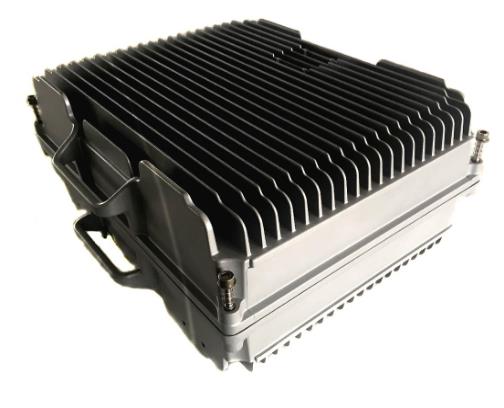
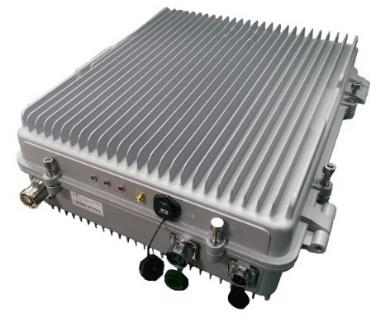
The EMTS 400MHz LMR/PMR In Line Booster (ILB) provides an excellent solution to the problem of insertion loss of passive components and transmission losses of feeder cables for Indoor Distributions or Tunnel Coverage. Using the ILB the LMR/DMR operator can easily expand a base station’s service area by compensation for feeder losses. The ILB amplifies the signals on the coax cables or leaky cables by using Advanced Bi- Directional Technology. Easy installation, lightweight design, and very friendly GUI make our ILB easy to use and install. The EMTS ILB is a cost-effective and practical solution for extending signal coverage inside buildings, shopping malls, airports, and tunnels where the LMR/DMR networks have poor coverage. The ILB is used to extend the coverage area in a passive distribution antenna system (DAS) connected by coaxial cables. EMTS ILB provides a wide range of configurations to address different customer requirements.
| Technical Specifications | |
|---|---|
| Downlink | Uplink |
| Electrical Specifications | |
| Frequency Range (350-512 MHz) | 350-512 MHz |
| * Please specify uplink and downlink bands | |
| Composite output Power (33dBm) | 24dBm |
| Gain (48±3dB) | 48±3dB |
| In-band ripple | ≤3dB |
| Gain adjustable range | ≥30dB |
| Gain adjustable step | 1dB |
| Noise figure | ≤4dB |
| VSWR | ≤2:1 |
| Transmission delay | ≤5us |
| Spurious | ≤-36dBm (9KHz to 1GHz) ≤-30dBm (1GHz to 12.5GHz) |
| External connection | |
| Connector | N-F / 50 ohms |
| Alarm Detection | HPA, LNA, TEMP, PSU, Digital IF module, Door Local LED display, Dry Contacts; RS232 local monitoring |
| Local Alarm; | Via USB connectivity using web browser PSU, HPA, LNA, Digital IF Module, Temp, Door open |
| NMS interface | Using ethernet connectivity or 4G modem or dry contact for summarized alarm |
| Power Supply | 110 to 220VAC ±15% 50-60Hz / 120 Watts (Optional: 24 Vdc or -48 VDC) |
| Environmental | |
| Operating Temperature Range | -20 to +55 °C |
| Cooling | Convection |
| Environmental Sealing | IP65 |
| Operating Humidity | Up to 95% (non-condensing) |
| Complies with | EN 301 489-18, ETSI TS 101 789-1, EN 60 950 |
| Standards | 390x320x100 mm |
| Weight | 18 kg (for the 5 watts type) |
| needs for Wireless Networks. | |
Tactical RF solutions typically combine communication, coverage and protection components into systems that fit a specific operational need. Defense, security and public safety projects often require equipment that standard catalogues do not cover, so this group brings together RF building blocks used in tactical and private network deployments, together with EMTS engineering support for customised systems.
In-line amplifiers are installed inside an existing distribution path, rather than taking a signal off-air. For example, they can restore signal levels after long cable runs, many splitters or leaky feeder sections. As a result, a private LTE or professional radio network can reach further without adding a new radio site or a new donor antenna.
Because they operate inside the distribution path, in-line amplifiers must match the band, the required gain and the input levels at their location. Therefore, check the datasheet for gain, output power and noise figure before adding one to a system.
In practice, many tactical projects combine several elements, such as private LTE coverage, professional radio, RF amplification and detection sensors. To scope a customised system, prepare:
See our private LTE network solution and drone detection systems. For professional radio coverage, explore TETRA and DMR coverage solutions, or return to the overview of counter-UAS detection and private LTE networks.
EMTS supports application-specific customisation. Requirements such as frequency, output power, form factor and interfaces are reviewed with our engineers for each project.
Contact EMTS to discuss your tactical RF requirements.