
| Technical Specifications | |
|---|---|
| Subsystem | Reference Architecture |
| LTE / 5G Monitoring Node | MIB/SIB and layer-3 broadcast decoding -> cell/spectrum metrics -> optional authorized |
| Acoustic Sensor Node | pre-processing -> STFT/Log-Mel features -> rotor-signature classifier -> GCC- |
| Fusion & C2 | Kalman/EKF tracking -> classification / geolocation -> GIS display, alarms and API |
| Parameter | Specification |
| Frequency range - base | 400 MHz to 6 GHz continuous monitoring target |
| Frequency range - option | 20 MHz to 8 GHz extended wideband receiver target |
| Priority UAS bands | 400/433 MHz, 868/915 MHz, 1.2-1.4 GHz, 2.4 GHz, 5.2/5.8 GHz; configurable |
| Receiver architecture | Multi-channel SDR / monitoring receiver with RF preselection, attenuation |
| Instantaneous bandwidth | 40 to 100 MHz class, receiver dependent |
| Antenna / coverage | 360° omnidirectional detection; optional 4/8/16-sector or interferometric DF |
| Direction finding | AoA / line-of-bearing, typical calibrated target <=3° in favorable LoS |
| Geolocation | Multi-node AoA triangulation; optional TDOA with synchronized receivers |
| Signal processing | Energy/occupancy analysis, protocol features, known-signature matching |
| Typical RF range target | Urban 1-3 km; rural/open LoS 2-5 km for common commercial UAS with |
| Environmental / interfaces | IP65 class; -20°C to +55°C target; GNSS, PTP/NTP, 1GbE, optional PoE++ and |
| Parameter | Specification |
| Scanner RF span - base | 350 MHz to 6 GHz |
| Optional wideband extension | 10 MHz to 8.5 GHz class for complete 5G NR FR1 coverage through 7.125 |
| Low bands | GHz /[R5] |
| 600 | 700 / 800 / 900 MHz families - e.g., LTE B12/B13/B20/B28 and NR |
| Mid bands | 1.7/1.8 GHz, 1.9/2.1 GHz, 2.3 GHz, 2.5/2.6 GHz - LTE |
| 5G FR1 C-band | n77 / n78 approximately 3.3-4.2 GHz; n79 approximately 4.4-5.0 GHz |
| Upper FR1 / shared spectrum | n46 / 5 GHz family where applicable; optional receiver extension for 6- |
| FR2 option | External downconverter/scanner module, typically 24-53 GHz class, only |
| Network decode | LTE and 5G NR broadcast system information to Release 17 class, |
| Typical update rate | 1-20 Hz aggregate engineering target depending on number of |
| Timing / interfaces | GNSS, PTP/NTP, 1GbE, API output; optional 5G/LTE backhaul modem |
| Parameter | Specification |
| Array configuration | 8 microphones standard; 16 recommended; optional 32/64-element |
| Microphone technology | Matched low-noise MEMS, digital PDM or low-noise differential |
| Microphone benchmark | 69-70 dB(A) SNR class, >=124 dB SPL AOP; low-frequency cutoff |
| Capture bandwidth | 20 Hz to 20 kHz nominal audio capture |
| Primary analysis band | 100 Hz to 8 kHz for rotor harmonic and blade-passing signatures; |
| Sampling / resolution | 48 kHz, 24-bit synchronized multichannel capture |
| Array geometry | Circular / hemispherical 250-500 mm aperture, phase calibrated, |
| Feature extraction | Wind/high-pass filtering -> STFT -> Log-Mel spectrogram -> |
| Classification | CNN / compact transformer: drone, non-drone, unknown; site- |
| Direction finding | GCC-PHAT / SRP-PHAT / beamforming; reference DOA target <=5° at |
| Reference range targets | Small multirotor: urban 100-250 m, rural/open 200-500 m; |
| Stage | Function |
| 1. Time alignment | GNSS / PTP timestamps are normalized to a common time base; |
| 2. Event normalization | Each sensor reports position/bearing, band/frequency, class probabilities, |
| 3. Association & gating | Candidate measurements are associated by time, angle, estimated position, |
| 4. Confidence fusion | Weighted Bayesian scoring or Dempster-Shafer evidence combination |
| 5. Tracking | Kalman / Extended Kalman filtering is the default constant-velocity tracker; |
| 6. Track management | Tentative -> confirmed -> coast -> dropped track logic prevents single- |
| 7. Threat / policy engine | User-defined zones, time-of-day rules, whitelist/authorized UAS data and |
| Parameter | Specification |
| Encryption | TLS 1.3 in transit; AES-256 class encryption at rest |
| commercial UAS | antenna. Stronger/louder or |
| multirotor | machinery, wind and microphone |
| wing / loud UAS | vector-sensor benchmarks for |
| SNR | control dominate error. |
| Parameter | Specification |
| System type | Passive multi-sensor Counter-UAS detection and situational-awareness |
| Sensor modalities | Wideband RF detection / DF, LTE/5G network monitoring, acoustic array |
| Coverage | 360° RF and acoustic coverage with site-dependent elevation coverage |
| Processing | Distributed edge analytics with centralized track fusion and web GIS |
| Node scale | 1 to 64 sensor nodes per fusion-server reference target; software-scalable |
| Concurrent tracks | >=100 track software target, configuration dependent |
| Time base | GNSS + PTP; NTP fallback |
| Event interfaces | REST/JSON, MQTT/TLS, WebSocket, SNMPv3, syslog; optional third-party C2 |
| Cybersecurity | mTLS, RBAC, signed updates, encrypted storage, audit logs |
| Deployment | Fixed site, temporary tripod, rooftop, mast, vehicle-supported sensor kit |
| Mitigation | Not included in base system; external authorized effectors may be integrated |
| Parameter | Specification |
| Ingress protection | IP65 minimum reference target; IP66 option where selected |
| Operating temperature | -20°C to +55°C standard target; -30°C to +60°C extended option |
| Storage temperature | -40°C to +70°C target, selected hardware dependent |
| Power input | 48 VDC PoE++ or 24/48 VDC; 100-240 VAC via external PSU option |
| Typical power - RF node | 25-60 W depending receiver / antenna electronics |
| Typical power - LTE node | 20-60 W depending network scanner and compute |
| Typical power - acoustic node | 10-25 W depending microphone count and edge compute |
| Mounting | Pole / mast / rooftop / tripod with surge protection and grounding |
| GNSS antenna | External active GNSS antenna or integrated sky-view module |
| Maintenance | Remote health monitoring, field-replaceable PSU/network |
| sites, data centers and industrial | area awareness and temporary high- private LTE or cellular backhaul. |
| campuses. | risk events. |
| Unauthorized drone delivery and | Rapidly deployable sensor nodes for Passive local airspace awareness and |
| restricted facilities. | authorization and local regulation. |
| connectivity. [R1] | [R4] |
Drone detection systems identify, classify and track small unmanned aircraft (UAS) near sensitive sites such as airports, borders, prisons, government facilities, critical infrastructure and temporary events. Detection is the foundation of any counter-UAS concept, because operators first need a reliable picture of what is in the air before any response is considered.
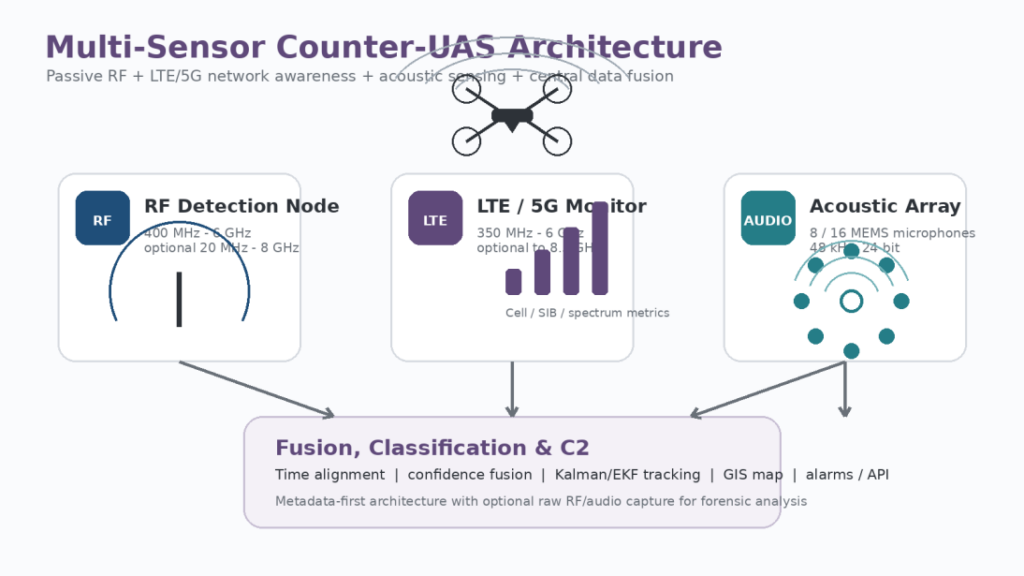
The MS-CUAS-360 is a modular, passive detection architecture that combines three sensing methods:
A fusion layer then correlates the measurements into a common track picture, with GIS display, alarms and open API interfaces for integration with security systems. According to its specification, it is a detection-only architecture: no RF jamming or mitigation transmitter is included. Values marked as design targets must be confirmed during acceptance testing.
The specification also describes urban and rural deployment profiles and redundant Ethernet, fiber or LTE/5G backhaul. In addition, the architecture explicitly excludes IMSI-catcher functions and the interception of subscriber content.
The group also includes a vendor-agnostic reference design for a distributed, multi-sensor counter-UAS detection network that combines RF control-link detection, cellular monitoring and acoustic sensor arrays.
Each sensing method has limits. RF sensing gives early warning for radio-controlled drones, while acoustic sensing helps when a drone flies without an active link. Therefore, combining sensors improves confidence, reduces nuisance alarms and maintains tracks when one sensor is affected by terrain, clutter or noise.
See the overview of counter-UAS detection and private LTE networks, or explore tactical RF solutions.
No. The MS-CUAS-360 reference specification is detection-only. Any mitigation capability is a separate system, and its use depends on local regulations and on official authorisation.
Contact EMTS to discuss detection requirements for your site.