
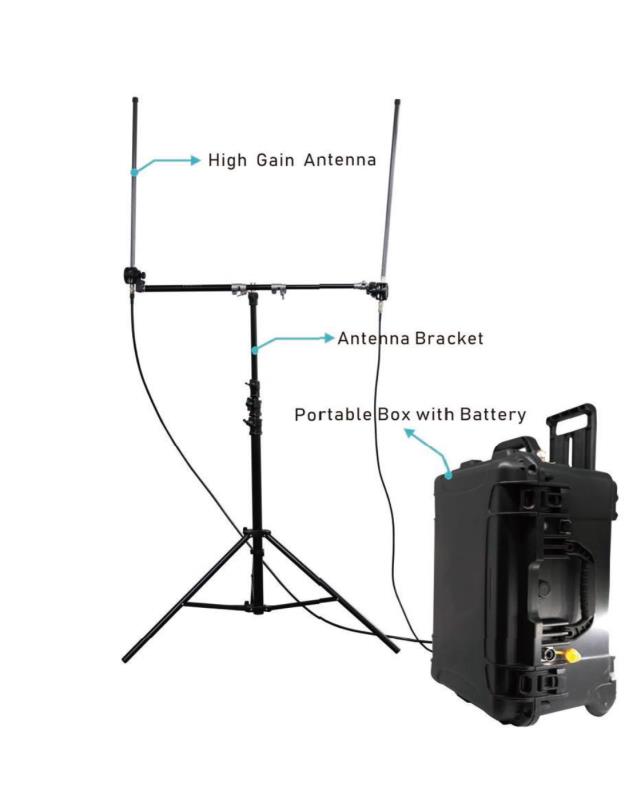
The Patron-P10 is a compact portable emergency communication platform designed to establish an independent LTE network for first responders and command centers. By combining radio access, core-network and multimedia dispatch functions, the system enables rapid voice, video and operational-data communications when conventional coverage is unavailable, congested or impractical.
Typical Applications Public Safety & Emergency Disaster Relief VIP Security Management
EMTS Telecom Services Ltd. offers a comprehensive portfolio of enhanced coverage solutions for the Wireless Networks, based on advanced technologies, EMTS’s proven, indoor and outdoor solutions solve a wide range of network
| Technical Specifications | |
|---|---|
| Item | Specification |
| Model | Patron-P10 |
| Technology | TD-LTE |
| Frequency Options | 400-430 MHz; 566-626 MHz; 1447-1467 MHz; 1785-1805 MHz |
| Channel Bandwidth | 5 / 10 / 20 MHz |
| Time Slot Ratio | 1:3, 2:2, 3:1 |
| RF Transmit Power | ≤ 30 W |
| RF Paths | 2 paths, 2T2R |
| UL / DL Data Rate | 50 / 100 Mbps |
| System Throughput | 1 Gbps |
| System Time Delay | < 300 ms |
| Maximum Users | 1,000 |
| Maximum Online PTT Calls | 200 |
| Transmission Port | IP Ethernet |
| Synchronization | GPS |
| Internal Battery | 4-6 hours |
| Operating Temperature | -40°C to +60°C |
| Storage Temperature | -50°C to +70°C |
| Air Pressure Range | 70-106 kPa |
| Environmental Protection | IP65 |
| Weight | < 25 kg |
| Dimensions | 580 × 440 × 285 mm |
| Supported Terminals & Deployment Modes | |
| Rapid Deployment & Flexible Field Operation | |
| and dispatch functions inside a rugged portable enclosure. | |
| Operational Highlights | |
| setup. | |
| • One-button startup minimizes commissioning effort and | |
| supports fast activation by field personnel. | |
| power configuration. | |
| • Supports portable PAD dispatch operation for command and | |
| coordination in the field. | |
| for harsh environments. | |
| Deployment Modes | |
| Manpack / Portable (Vehicle-Mounted) | On-Board / UAV |
| Portable operation for mobile field teams and (Integration in emergency or command vehicles) | Supports on-board deployments and integration |
| temporary command posts. (for rapidly moving operations.) | with unmanned aerial platforms. EMTS Telecom Services is a leading supplier of high-quality RF coverage solutions designed to maximize wireless all major mobile technologies and standards of wireless Networks. |
| Application Scenarios | |
| Disaster Relief | Search & Rescue |
| Rapidly restore operational communications when fixed or public | Connect rescue teams with command personnel using PTT voice, live |
| infrastructure is damaged or inaccessible. | video and operational data in difficult environments. |
| VIP Security | Public Safety & Emergency Management |
| Provide a deployable private network for coordinated security teams, | Support first responders and decision-makers with real-time voice, |
| mobile command and protected operational communications. | video, dispatch and GIS information. |
| Communication Services | |
| PTT / Trunking (Live Video) | IP Data / GIS / Positioning / Multimedia Dispatch EMTS Telecom Services is a leading supplier of high-quality RF coverage solutions designed to maximize wireless all major mobile technologies and standards of wireless Networks. |
| Supported Terminals & Multimedia Dispatch | |
| Field Communications | awareness. • Interworking with PLMN, PSTN and trunking systems where |
| • Broadband trunking handset for voice, data, video and GIS | required. |
| services. | |
| Wi-Fi access. | |
| devices. | |
| Representative Dispatch Functions | |
| PTP & Group Calls (Emergency Calls) | Conference / Broadcast / Floor Preemption |
| Video Upload & Distribution (Video Collaboration) | GIS Tracking & Playback / User Mapping & Grouping Terminal availability and specific software functions may depend on the selected system configuration and project requirements. EMTS Telecom Services is a leading supplier of high-quality RF coverage solutions designed to maximize wireless all major mobile technologies and standards of wireless Networks. |
| Why a Private LTE Network for Emergency Operations? | |
| unavailable. | |
| Customized Design | The network can be configured for mission-specific applications used by public safety, emergency management, government and other professional users. |
| Security | Supports multi-level authentication and encryption mechanisms, with controlled terminal identification and access. |
| Flexible Deployment | The network can be rapidly deployed at the required operational location without dependency on fixed telecom infrastructure. |
| Operational Reliability | Dedicated network resources remain available to authorized users and are not consumed by public traffic during an emergency. |
| Priority & Controllability | The operator can manage priority users, service quality and available resources according to the operational need. |
| Operational Value | |
A private LTE network gives emergency services, security teams and field operators their own cellular coverage. This matters when public networks are unavailable, congested or impractical. In addition, a rapidly deployable system can start operating at an incident site, a disaster zone or a temporary command post after a short setup.
The Patron-P10 is a compact, portable emergency communication platform that establishes an independent LTE network for first responders and command centers. According to its datasheet, it integrates the baseband unit (BBU), remote radio unit (RRU) and core network (EPC). It also includes multimedia dispatch functions, all in one rugged portable enclosure.
According to the datasheet, the internal battery supports about 4 to 6 hours of operation, and the unit weighs less than 25 kg.
For example, the system supports manpack or portable use and installation in command or emergency vehicles. It also supports on-board integration with unmanned aerial platforms. Typical applications include disaster relief, search and rescue, VIP security and public safety emergency management.
First, confirm the available spectrum and licence before deployment. Then define the coverage area, the number of users and the services required. In addition, check the terminals that will join the network and any required connection to external networks or command systems.
For related solutions, see drone detection systems and tactical RF solutions, or return to the overview of counter-UAS detection and private LTE networks.
No. It is designed to establish an independent LTE network. External connectivity depends on the project configuration.
Contact EMTS to discuss a private LTE network.