5G NR Power-Amplifiers

5G NR Power Amplifiers for n77, n78 and n79

5G NR power amplifiers in this group are multi-carrier amplifiers for the mid-band 5G spectrum between 3.3 GHz and 5 GHz. For example, they serve as power stages in 5G repeaters, distributed antenna systems and radio equipment, where wide signal bandwidths and high peak to average power ratios demand excellent linearity.

Models in this group

  • An n77 amplifier for 3.3 to 3.7 GHz
  • An n78 amplifier for 3.7 to 4.1 GHz
  • A wideband n77/n78 amplifier for 3.3 to 4.2 GHz, designed for LTE-Advanced and 5G NR TDD radio systems
  • An n79 amplifier for 4.4 to 5 GHz
  • A 617 to 821 MHz high-efficiency amplifier rated at 200 W for low band 4G and 5G deployments

Each datasheet lists the output power rating, which ranges from 10 W to 20 W for the mid-band models. In addition, several of these models target multi-channel LTE and 5G applications.

Linearity and bandwidth in 5G

5G NR carriers can be much wider than LTE carriers. Therefore, an amplifier must remain linear across a wider instantaneous bandwidth. Key parameters to compare are ACLR, EVM, gain flatness, efficiency and TDD switching behaviour. In addition, digital pre-distortion (DPD) can improve linearity, depending on the amplifier and the system design. Efficiency also matters, because 5G radio units often operate in compact enclosures where heat must be managed carefully.

Choosing between models

First, start with the 3GPP band used in your network: n77, n78 or n79. Then select the output power that the host equipment needs, and finally confirm the supported signal bandwidth. For LTE bands, see our LTE power amplifiers. For special frequency ranges, see wideband RF amplifiers. You can also explore our 5G coverage solutions or return to all high-linearity RF power amplifiers.

Frequently asked questions

Are these amplifiers suitable for TDD?

Yes. n77, n78 and n79 are TDD bands, and the datasheet of the wideband n77/n78 model names TDD radio systems explicitly. Confirm switching requirements in the datasheet.

Can these amplifiers be customised?

Yes. We can tailor frequency range, output power and form factor on request. Share your requirements with our engineers.

Contact EMTS to discuss your 5G amplifier requirements.
MCPA-3500-43W50 5G Power Amplifier Multi-Carrier Solid State

5G n77 3.3-3.7GHz 20W Multi-Carrier Solid State Power Amplifier

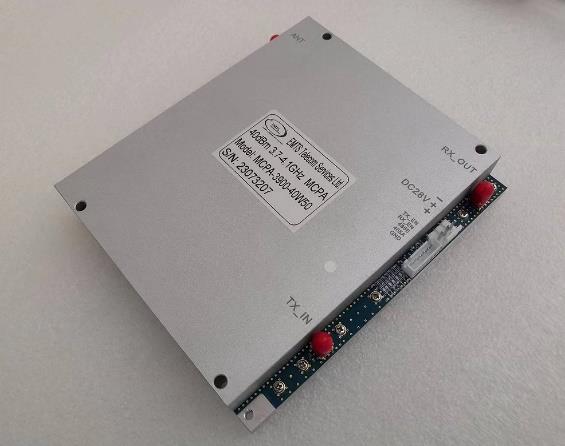
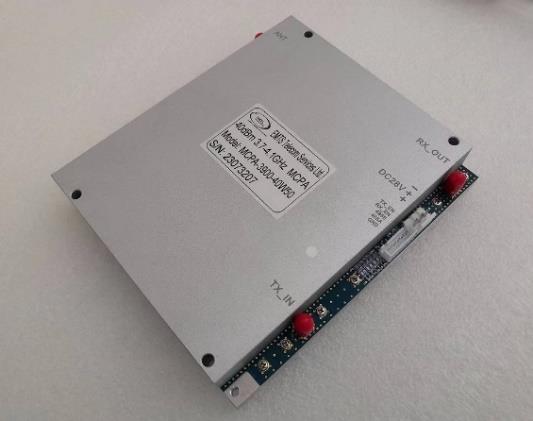
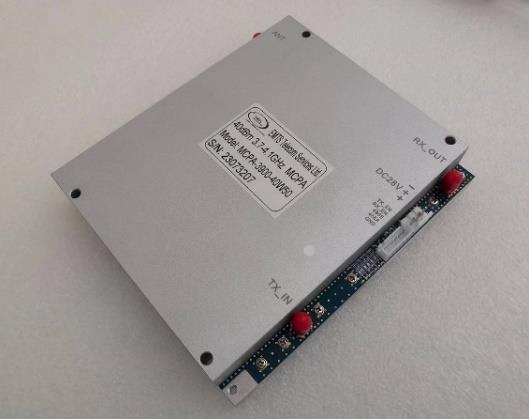
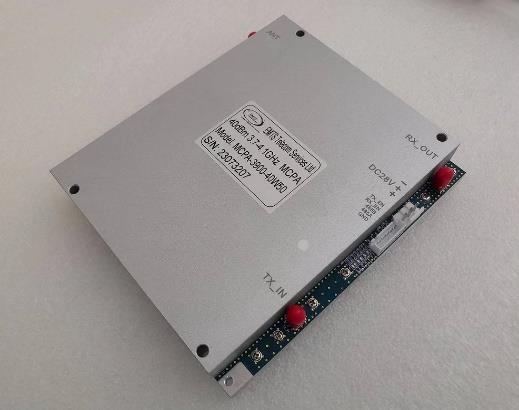
MCPA-3900-40W50 5G Solid State Multi-Carrier Power Amplifier

5G n78 3.7-4.1 GHz 20W Multi-Carrier Solid State Power Amplifier

MCPA-3750-40W50 5G Solid State Multi-Carrier Power Amplifier

5G n77, n78 3.3-4.2 GHz 10W Multi-Carrier Solid State Power Amplifier

MCPA-4750-40W50 5G Solid State Multi-Carrier Power Amplifier

5G n79 4.4-5GHz 10W Multi-Carrier Solid State Power Amplifier

MCPA-6182-53W45A Multi-Carrier Solid State Wide Band Power Amplifier

617-821MHz 200W Multi-Carrier Solid State Power Amplifier

5G n77 3.3-3.7GHz 20W Multi-Carrier Solid State Power Amplifier

Download Datasheet (PDF)

The EMTS Telecom Power-Amplifier model MCPA-3500-43W50 is designed for multi-channel LTE and 5G applications in the band of 3.3-3.7GHz. This amplifier utilizes linear LDMOS power devices that provide high gain, wide dynamic range, low distortions, and excellent group delay and phase linearity. Exceptional performance, long-term reliability, and high efficiency are achieved using APD (Analog Pre-distortion) technology, advanced matching networks, and combining techniques (Doherty Design). The MCPA supports TDD modulation, and d includes Uplink and Downlink paths. EMI/RFI filters, machined housings, and qualified components. EMTS Cellular Power Amplifiers are ideal for customers with DAS systems, BTS solutions, and RF repeaters. The MCPA utilized the Linearization technique to provide excellent efficiency, and linearity characteristics offer low distortion and EVM. EMTS's high-quality design makes the MCPA extremely stable within an overall environmental temperature range

EMTS Telecom Services Ltd. offers a comprehensive portfolio of enhanced coverage solutions for the Wireless Networks, based on advanced technologies, EMTS’s proven, indoor and outdoor solutions solve a wide range of network issues including interference and oscillation problems, challenging coverage holes, rapid response deployment, and complex network needs for the Wireless Networks.

Key Features

  • Support LTE and 5G air protocol at the band of 3.3-3.7GHz
  • Designed to meet ETSI requirements for LTE and 5G networks
  • Support TDD applications with both uplink and downlink path
  • Solid-state linearized design with a linear output power
  • High efficiency, High reliability, and ruggedness design
  • Built-in Control & Monitoring Circuits
  • Stable characteristics in the wide temperature range
  • Field proved reliability
Technical Specifications
Technical Specification
Item (Indicator)Remark
RXTX
5G NR-FR1-TM3.1(TDD)Typical 20M signal
Test sourcetest ([email protected]%)
Electrical Performance
Frequency range3300-3700MHz No damage for 30
Maximum input level (-10dBm)10dBm / minutes
Output power Pmax (≥0dBm)≥43 dBm
Gain (35±1 dB)52±1 dB
Passband Ripple△GP≤3.0dB
≤-45dBc @±5MHz≤-30dBc @±5MHz
ACLR (ACPR)
ALC control range≥10dB
ATT range (/)≥22dB
Noise (≤4dB)/
EVM( TM3.1/3.2/3.3 mode)≤4.5%
VSWR≤1.5:1
RF T/R switchComply
TX&RX
Switch switching delay
RX to TX Isolation80dBc
Input power detection-30 dBm to 0 dBm
Output power detection15dBm to 44dBm
Reflected power detection10dBm to 42dBm
Fault alarmHave
VSWR alarm (default 2.5)Settable
Temperature detection-40 to 100℃
Working voltage (28DCV)28-30DCV
Static working current≤2A
Dynamic working current≤3.5A EMTS Telecom Services is a leading supplier of high-quality RF coverage solutions designed to maximize
Mechanical and Environmental Performance
temperature range (-40~85℃)Operating
RF interface (PA IN ->input port of power amplifier: MCX)Customizable straight connector (Note1:There are two interfaces, one for standby) LNA OUT ->Low noise amplifier output port: MCX in-line connect
RS485 interface + (1 * 4Pin 2.0 spacing)(Factory equipped
Pin 1:RS485A;with 30cm long
Pin 2:GND;connecting cable) Pin 3:RS485B; Pin 4:VCC;
synchronous control1 * 4Pin 2.0 spacing Pin 1: TX_ENA external input power amplifier is enabled, the power amplifier is turned off when the power is low, and the power amplifier is turned on when the power is high; Pin 2:GND Pin 3: RX_ENA external input low noise amplifier enabled, low noise amplifier is turnedoff at low power level, and low noise amplifieris turned on at high power level; Pin 4:NC
Power interface (VH3.96-2P)Factory equipped
Pin 1 GND Pin 2: 28VDCwith 30cm long connecting cable
Module appearanceAluminum natural color
SizeL160*W110*H22.5
Mounting hole sizeM4 EMTS Telecom Services Ltd. offers a comprehensive portfolio of enhanced coverage solutions for the Wireless Networks, based on advanced technologies, EMTS’s proven, indoor and outdoor solutions solve a wide range of network issues including interference and oscillation problems, challenging coverage holes, rapid response deployment, and complex network needs for the Wireless Networks.
Outline Drawing

5G NR Power Amplifiers for n77, n78 and n79

5G NR power amplifiers in this group are multi-carrier amplifiers for the mid-band 5G spectrum between 3.3 GHz and 5 GHz. For example, they serve as power stages in 5G repeaters, distributed antenna systems and radio equipment, where wide signal bandwidths and high peak to average power ratios demand excellent linearity.

Models in this group

  • An n77 amplifier for 3.3 to 3.7 GHz
  • An n78 amplifier for 3.7 to 4.1 GHz
  • A wideband n77/n78 amplifier for 3.3 to 4.2 GHz, designed for LTE-Advanced and 5G NR TDD radio systems
  • An n79 amplifier for 4.4 to 5 GHz
  • A 617 to 821 MHz high-efficiency amplifier rated at 200 W for low band 4G and 5G deployments

Each datasheet lists the output power rating, which ranges from 10 W to 20 W for the mid-band models. In addition, several of these models target multi-channel LTE and 5G applications.

Linearity and bandwidth in 5G

5G NR carriers can be much wider than LTE carriers. Therefore, an amplifier must remain linear across a wider instantaneous bandwidth. Key parameters to compare are ACLR, EVM, gain flatness, efficiency and TDD switching behaviour. In addition, digital pre-distortion (DPD) can improve linearity, depending on the amplifier and the system design. Efficiency also matters, because 5G radio units often operate in compact enclosures where heat must be managed carefully.

Choosing between models

First, start with the 3GPP band used in your network: n77, n78 or n79. Then select the output power that the host equipment needs, and finally confirm the supported signal bandwidth. For LTE bands, see our LTE power amplifiers. For special frequency ranges, see wideband RF amplifiers. You can also explore our 5G coverage solutions or return to all high-linearity RF power amplifiers.

Frequently asked questions

Are these amplifiers suitable for TDD?

Yes. n77, n78 and n79 are TDD bands, and the datasheet of the wideband n77/n78 model names TDD radio systems explicitly. Confirm switching requirements in the datasheet.

Can these amplifiers be customised?

Yes. We can tailor frequency range, output power and form factor on request. Share your requirements with our engineers.

Contact EMTS to discuss your 5G amplifier requirements.