Fiber DAS vs RF repeaters is one of the first decisions in any in-building cellular project. In short, an off-air RF repeater is usually the faster and more economical choice for a single building zone that already receives a usable outdoor signal. A fiber distributed antenna system (DAS), on the other hand, is the better choice for large, multi-floor or multi-operator sites that need consistent coverage, capacity and room to grow. This guide explains how each option works, where it fits and what to prepare before you ask for a design.
Fiber DAS vs RF repeaters: how the two approaches differ
Both approaches solve the same problem: modern buildings block radio signals. Low-emissivity glass, reinforced concrete and metal structures can reduce indoor signal levels to the point where calls drop and data slows down. The difference lies in where the signal comes from and how it is distributed inside the building.
How an off-air RF repeater works
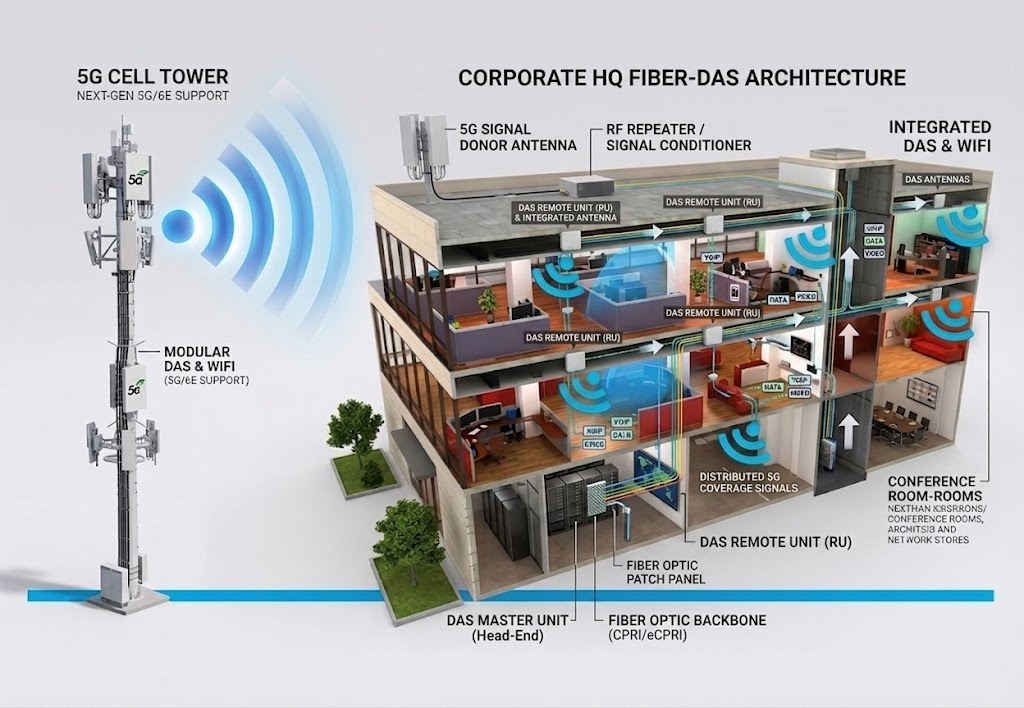
An off-air repeater, also called a bi-directional amplifier, uses a donor antenna, usually on the roof, to receive the signal from a nearby base station. The repeater amplifies this downlink signal and feeds it to one or more service antennas inside the building. At the same time, it amplifies the uplink signal from mobile phones back towards the base station.
Because the repeater reuses an existing outdoor signal, it extends coverage but does not add network capacity. Its performance also depends on the quality of the donor signal and on the isolation between the donor and service antennas, which limits the usable gain. The EMTS range of cellular RF repeaters spans compact mini repeaters to high power models, in single, dual, triple and quad band versions.
How a fiber DAS works
A fiber DAS starts at a headend, where a master unit connects to a signal source. This can be a dedicated base station, several operators’ base stations combined through a point of interface (POI), or an off-air repeater. The master unit converts the RF signal to optical and sends it over fiber to remote units across the building. Each remote unit then converts the signal back to RF and feeds nearby antennas.
Since optical fiber has very low loss compared with coaxial cable over long runs, remote units can be placed exactly where coverage is needed, including distant wings, car parks and tunnels. In addition, when the DAS is fed by a base station, it brings dedicated capacity to the building. See our fiber DAS systems for master and remote unit options.
Fiber DAS vs RF repeaters: side-by-side comparison
| Criterion | Off-air RF repeater | Fiber DAS |
|---|---|---|
| Typical site | Single zone or small to mid-size building | Large, multi-floor or campus sites |
| Signal source | Outdoor donor signal | Base station, POI or off-air donor |
| Capacity | Shares the capacity of the donor cell | Can add dedicated capacity when fed by a base station |
| Multiple operators | Possible with suitable models and operator approval | Designed for multi-operator, multi-band distribution |
| Installation | Faster, with fewer components | Longer design and installation, fiber routes required |
| Scalability | Limited by gain and antenna isolation | Add remote units as the site grows |
| Upfront cost | Lower | Higher |
When an RF repeater is the right choice
- A defined area with weak indoor coverage, such as an office floor, a warehouse or a basement
- A usable outdoor signal from the operator you need to serve
- One or a few frequency bands
- A limited budget or a short installation window
- Rural sites, roads and industrial areas far from the nearest cell
Output power also matters. Mini repeaters suit small areas, while high power repeaters can serve larger indoor spaces or outdoor coverage extension, provided the antenna isolation supports the required gain.
When a fiber DAS is the better investment
- Large buildings, hospitals, airports, campuses and stadiums
- Several operators or several radio services on one infrastructure
- Sites where capacity, and not only coverage, is the problem
- Long distances between the signal source and the coverage areas
- Projects that need MIMO for higher 4G and 5G throughput
EMTS fiber DAS families include cellular systems with MIMO remote units and dedicated systems for TETRA, DMR and P25. For 5G NR projects, see our 5G coverage solutions.
Hybrid designs
Many projects combine both approaches. For example, an off-air repeater can act as the signal source for a fiber DAS, bringing an outdoor signal into the headend and distributing it across a large site. Another approach uses fiber to reach remote zones and passive coaxial distribution inside each zone, which reduces cost where active equipment is not needed.
Regulatory and operator considerations
Repeaters and DAS equipment retransmit licensed spectrum, so operator consent and local regulations apply in most countries. In the United States, for instance, signal boosters are regulated under 47 CFR 20.21, which includes operator consent requirements. Equipment performance is specified against standards such as 3GPP TS 38.106 for NR repeaters and the ETSI EN 301 908 series in Europe. Therefore, always confirm the applicable rules with the network operator before installation.
What to prepare before requesting a design
- Floor plans and the areas that need coverage
- Operators, frequency bands and technologies, including any public safety radio
- Measured or estimated outdoor signal levels
- Expected number of users and capacity needs
- Available cable routes, equipment rooms and power
With this information, an engineer can tell you whether a repeater, a fiber DAS or a hybrid design fits, and which products to specify. If your project also includes first responder radio, read our guide to TETRA and DMR in-building coverage.
Frequently asked questions
Is a fiber DAS always better than an RF repeater?
No. A repeater is often the better fit for a single zone with a usable donor signal. A fiber DAS pays off on large or multi-operator sites that need capacity and scalability.
Can a repeater and a fiber DAS work together?
Yes. An off-air repeater can feed the headend of a fiber DAS, which then distributes the signal to remote units across the site.
Does an RF repeater increase network capacity?
No. A repeater extends the coverage of an existing cell and shares its capacity. In contrast, a DAS fed by a dedicated base station can add capacity.
Do these systems support 5G?
Yes, with suitable equipment. EMTS offers n78 and n79 repeaters, dual band 4G/5G repeaters and an n78 fiber DAS with 4×4 MIMO support.
Do I need operator approval?
In most countries, yes. Repeaters and DAS equipment retransmit licensed spectrum, so check operator consent and local rules before installation.
Not sure which approach fits your building? Contact the EMTS engineering team with your floor plans and band list for a project recommendation.